
This document describes the I-V relationship of MOS transistors and their dynamic behavior.
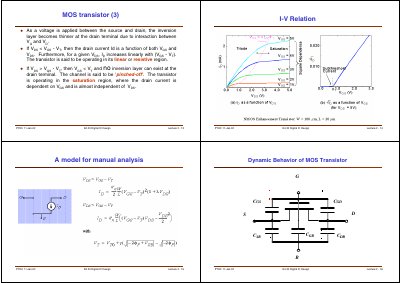
This document provides lecture notes on the I-V relationship of MOS transistors. It explains the conditions for the linear (resistive) region where drain current depends on both gate-source and drain-source voltages, and the saturation region where the channel is pinched off and current is independent of drain voltage. The text includes a graph illustrating the square dependence of current on voltage.
When Vds is less than Vgs - Vt, the drain current Id depends on both Vgs and Vds, and for a given Vds it increases linearly with (Vgs - Vt). The transistor is then operating in its linear or resistive region.
When Vds is greater than Vgs - Vt, no inversion layer can exist at the drain terminal and the channel is pinched off. In the saturation region the drain current depends on Vgs and is almost independent of Vds.