
This product is a current signal arrester, model AR-HA, suitable for 10 to 50mA DC.
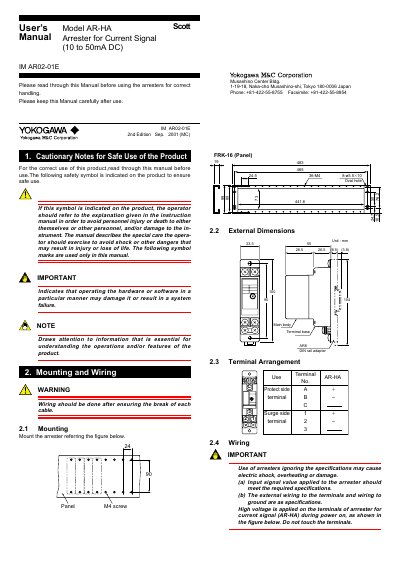
This manual is the instruction manual (IM ARO2-01E, 2nd Edition, Sep. 2001) for the Yokogawa Model AR-HA arrester for current signal lines rated 10 to 50 mA DC. It explains the safety symbols used on the product, how to mount the arrester on a panel or DIN rail adapter, terminal arrangement, wiring and grounding requirements, and how arresters are connected with the instruments they protect, such as transmitters and analyzers.
The manual also gives the environmental conditions, hardware specifications such as leakage current, voltage limit, discharge starting voltage and surge discharge withstand capacity, and maintenance procedures including replacement of the plug-in arrester main body and periodic performance checks with the optional checker.
| Signal current range | 10 to 50 mA DC |
|---|---|
| Permissible current leakage, between lines | 5 µA or less (at 70 V DC) |
| Permissible current leakage, between ground | 10 µA or less (at 80 V DC) |
| Instrument side voltage limit, between lines | 90 V or less (at 10 kV, 1.2/50 µs) |
| Instrument side voltage limit, between ground | 380 V or less (at 10 kV, 1.2/50 µs) |
| Surge discharge withstand capacity | 1000 A (at 8/20 µs), between lines and between ground |
| Discharge starting voltage, between lines | 75 V or more |
| Discharge starting voltage, between ground | 135 V or more |
| Maximum load current | 100 mA |
| Series resistance | 33.2 Ω |
| Ambient temperature | 0 to 50°C |
| Relative humidity | 5 to 90%RH (no condensation) |
| Altitude at installation site | Max. 2000 m above sea level |
| Ground resistance | 100 Ω or less (JIS Class 3 grounding) |
| Signal cable conductor cross-section | 0.5 to 0.75 mm² |
| Grounding cable conductor cross-section | 2.0 mm² or more |
At least once a year; in areas where lightning occurs frequently, checks should be done more often, particularly after thunderstorms.
No. High voltage (65 V DC) is applied on the terminals of the arrester for current signal during power on, so the terminals must not be touched.
Yes. The main body and terminal base are connected by plug-in, and the circuit between surge side and protect side is not opened even when the main body is removed, so it can easily be replaced.
Make sure the model and suffix codes on the labels of the main body and terminal base are the same.