
Langfeng T series solid state relay adopts photoelectric isolation AC zero-crossing trigger technology and DC constant current source technology, with the characteristics of shockproof, moisture-proof, anti-corrosion, explosion-proof, fast switching speed, no noise, long life, no spark, etc.
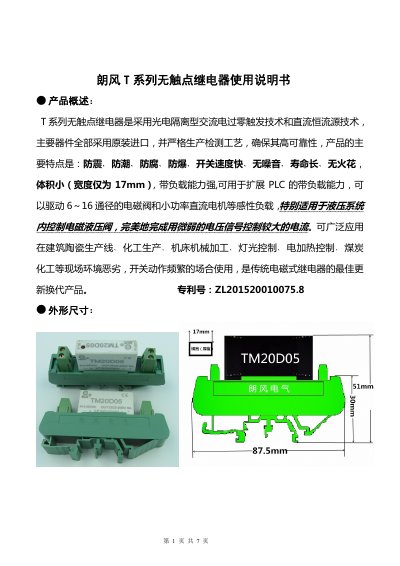
The Langfeng T series contactless relay (solid state relay) uses photoelectric isolation AC zero-crossing trigger technology and DC constant current source technology, with its main components imported. It is shockproof, moisture-proof, corrosion-proof and explosion-proof, switches fast, runs silently with no sparks, is only 17 mm wide, and can expand a PLC's load capacity to drive 6-16 mm solenoid valves and small DC motors. Langfeng states it suits harsh sites with frequent switching, such as building ceramic lines, chemical production, machine tools, lighting control, electric heating and coal chemical industries.
The manual gives the model code (for example, TM20D05: 5 A maximum load current, DC 3.2-32 V control signal, DC load, 200 V device withstand voltage), wiring diagrams, and connection methods for controlling inverters (only TM20D05 and TM20A05), solenoid valves and PLC inputs. It also lists precautions, such as never measuring input-output insulation with a megohmmeter and observing terminal polarity, plus a parameter table (5.0 A rated RMS current, 5-15 mA control current, below 1 Vdc release voltage, 10 A short-time maximum load current). This manual is written in Chinese.
| Rated current (RMS) | 5.0 A |
|---|---|
| Control voltage range (DC models) | DC 3.2-32 V, constant current source |
| Control voltage range (AC models) | AC 160-280 V |
| Control current range | 5-15 mA |
| Must release voltage | Below 1 Vdc |
| Line voltage range | DC 12-200 V (T44D05/T44A05: AC 40-440 V) |
| Maximum load current (short time) | 10 A |
| On-state voltage drop | Minimum 0.15 VDC |
| Width | 17 mm |
| Maximum response frequency | 1 kHz |
Only the TM20D05 and TM20A05. The inverter's multifunction terminal common (com or sd) connects to the relay output negative, and STF, STR or AH terminals connect to the output positive.
Yes. Its input uses a constant current source circuit with a very small drive current, so a photoelectric or proximity switch can trigger it directly even over long signal lines (3.2-32 VDC).
Because such a load cannot complete a circuit, so the relay does not work with it.
5.0 A RMS, with a short-time maximum load current of 10 A.