
The D108 series moving coil vocal microphone has the following features: balanced and clear original sound reproduction; frequency response with speech characteristics, bright mid-high frequency sound quality, pure bass, with proximity effect; hypercardioid指向性, strong ability to suppress sound feedback; ON/OFF mute control switch with lock function; modular design, gold-plated connectors; metal structure, elastic hardened mesh head, wear-resistant titanium gray surface coating (type A), black sand grain paint (type B).
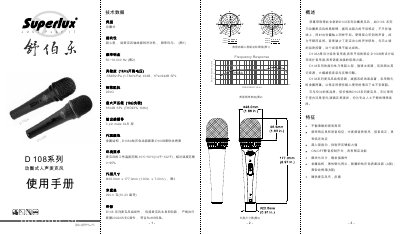
The Superlux D108 Series is a moving coil vocal microphone available in two versions: the D108A, designed for recording with a flat response, and the D108B, designed for live sound reinforcement with a moderately boosted low-frequency response. Both use a supercardioid polar pattern and include an ON/OFF mute switch with a lock function, gold-plated connectors, a metal body, and a hardened metal grille.
Technical data in the manual list a frequency response of 50 to 16,000 Hz, sensitivity of -55 dBV/Pa (1.78 mV/Pa), nominal impedance of 250 ohms, and maximum SPL of 160 dB. The manual also explains microphone setup and maintenance, notes that the supercardioid pattern is least sensitive at 120 to 135 degrees off-axis, and describes proximity effect, supplied accessories such as the HM38S clip and pouch, and optional accessories. This manual is written in Chinese.
| Polar pattern | Supercardioid |
|---|---|
| Frequency response | 50~16,000 Hz |
| Sensitivity | -55dBV/Pa (1.78mV/Pa) ±3dB at 1 kHz open-circuit |
| Nominal impedance | 250Ω |
| Maximum SPL | 160dB SPL (THD≦1% 1kHz, 1kΩ load) |
| Output connector | 3 pin male XLR |
| Dimensions | Φ48.0mm x 177.0mm (1.90in. x 7.00in.) |
| Net weight | 290.0 g (10.23 oz) |
| Operating temperature | -10℃~50℃ (14℉~122℉) |
| Relative humidity | 0~95% |
| Finish | D108A titanium gray paint; D108B black sand-texture baked enamel |
The D108A is designed for recording with a flat response, while the D108B is designed for live sound reinforcement with a moderately boosted low-frequency response.
It uses a supercardioid pattern that is symmetrical around the microphone axis.
It is least sensitive to sound sources at 120 to 135 degrees off-axis.
A microphone clip and a leather pouch are supplied.