
E10A/E10B is a low-impedance capacitive head-worn microphone designed for close-range speaking. It is suitable for activities such as sports, interviews, theater, and instrument playing. The new design of the microphone cable path is more streamlined and the comfortable shape allows for long-term use without fatigue. It provides a wide frequency response curve and offers the best wearing method. The net weight is 30 grams and it is suitable for a temperature range of -10℃~50℃ and a relative humidity range of 0~95%.
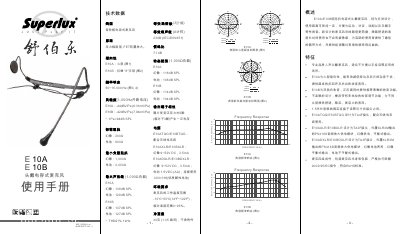
The Superlux E10A and E10B are low-impedance capacitive head-worn microphones designed for close-talk applications in sports, interviews, theater, and musical performances. The E10A features a cardioid pickup pattern, while the E10B offers an omnidirectional figure-8 pattern. Both models are designed for comfort during long-term use with a simplified and hidden cable path. This manual is written in Chinese.
| Net Weight | 30g (1.05 oz) |
|---|---|
| Operating Temperature | -10℃~50℃ |
| Relative Humidity | 0~95% |
| Frequency Response | 50~15,000 Hz |
| Sensitivity (E10A Phantom) | -44 dBV/Pa |
| Sensitivity (E10B Phantom) | -42 dBV/Pa |
| Signal-to-Noise Ratio | 71 dB |
| Max SPL (E10A Phantom) | 116dB SPL |
| Max SPL (E10B Phantom) | 114dB SPL |
The net weight is 30g (1.05 oz), excluding accessories.
The E10AXLR/E10BXLR models require phantom power of 9~52V DC, 3.5mA.
The frequency response range is 50~15,000 Hz.
The signal-to-noise ratio is 71 dB.