
Potassium Sodium Hydrogen Citrate Granules, used to dissolve uric acid stones and prevent recurrence
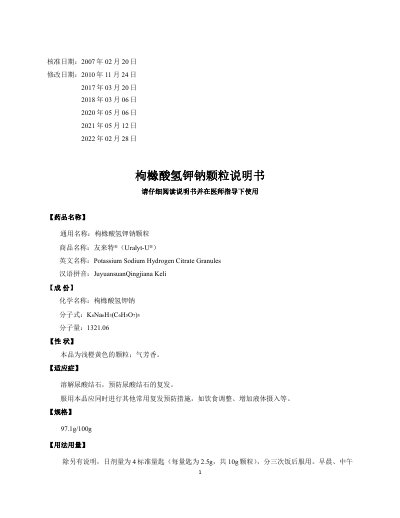
This is the Chinese package insert (说明书) for Uralyt-U (友来特), potassium sodium hydrogen citrate granules. The marketing authorization holder is Meda Pharma GmbH & Co. KG, Bad Homburg, Germany, and the manufacturer is Martin Bauer GmbH & Co. KG, Kleinostheim, Germany. The stated indication is dissolving uric acid stones and preventing their recurrence, together with other recurrence-prevention measures such as dietary adjustment and increased fluid intake.
The insert gives the dosage — 4 standard measuring spoons (2.5 g each, 10 g of granules) per day in three doses after meals — and the target fresh-urine pH of 6.2–6.8, including how to measure urine pH with the supplied test strips and color chart and how to adjust the evening dose. It also covers adverse reactions, contraindications, precautions, use in pregnancy and children, drug interactions, overdose, pharmacology and toxicology, pharmacokinetics, storage, packaging, shelf life and approval numbers. This manual is written in Chinese.
| Active ingredient | Potassium sodium hydrogen citrate (枸橼酸氢钾钠) |
|---|---|
| Molecular formula | K6Na6H3(C6H5O7)5 |
| Molecular weight | 1321.06 |
| Appearance | Light orange-yellow granules with an aromatic odor |
| Specification | 97.1 g/100 g |
| Daily dose | 4 standard measuring spoons, 2.5 g each (10 g of granules), in three doses after meals |
| Maximum daily dose | 11.25 g of granules (4.5 measuring spoons), equal to 1.86 g potassium and 1.09 g sodium |
| Potassium content | 1 g of potassium sodium hydrogen citrate contains 0.172 g or 4.4 mmol potassium |
| Sodium content | 1 g contains 0.1 g or 4.4 mmol sodium, equivalent to 0.26 g sodium chloride |
| Shelf life | 60 months |
Unless otherwise stated, the daily dose is 4 standard measuring spoons of 2.5 g each (10 g of granules), divided into three doses after meals: one spoon in the morning, one at noon and two in the evening.
For dissolving uric acid stones and preventing recurrence, the fresh urine pH must be between 6.2 and 6.8.
If the pH is below the recommended range, the evening dose is increased by half a measuring spoon; if it is above the range, the evening dose is reduced by half a spoon.
The granules can be taken dissolved in water.