
Tools to Screen for Alcohol and Other Substance Use in College Students
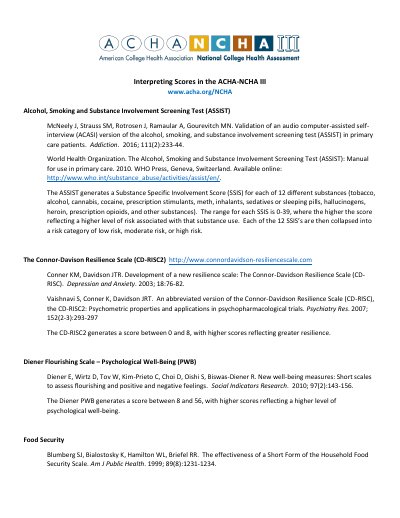
This two-page ACHA reference sheet, "Interpreting Scores in the ACHA-NCHA III," explains how the scores produced by several screening instruments used in the survey are read and grouped. For each instrument it lists the source reference, the range of possible scores and what a higher score means.
The instruments covered are the Alcohol, Smoking and Substance Involvement Screening Test (ASSIST), the Connor-Davidson Resilience Scale (CD-RISC2), the Diener Flourishing Scale for psychological well-being, the USDA six-item food security short form, the Kessler 6 (K6), the short UCLA Loneliness Scale (ULS3) and the Suicide Behaviors Questionnaire - Revised (SBQ-R). Where applicable, the sheet also states the risk categories the score is collapsed into.
Each of the 12 substance-specific scores ranges from 0 to 39, with a higher score reflecting a higher level of risk for that substance. Each score is then collapsed into low, moderate or high risk.
A K6 score of 13 to 24 reflects serious psychological distress, while 5 to 12 reflects moderate psychological distress.
The short UCLA Loneliness Scale runs from 3 to 9; a score of 6 to 9 reflects a positive screening for loneliness.
A score of 0-1 reflects high or marginal food security, 2-4 reflects low food security and 5-6 reflects very low food security.