
This standard specifies the technical requirements for dry, non-enclosed, sealed-terminal, three-phase distribution transformers.
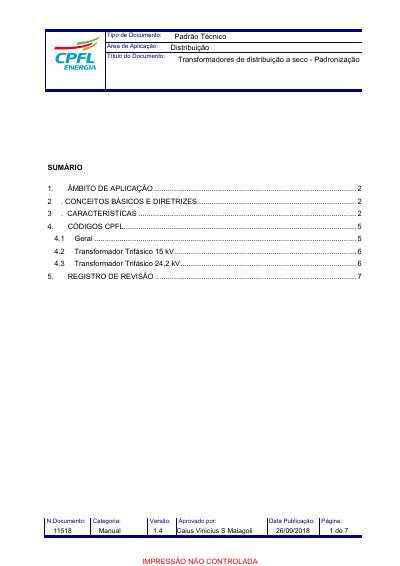
CPFL Energia document 11518 sets the standard for three-phase, dry, non-enclosed transformers with encapsulated windings used in distribution systems. It applies to units with maximum voltage up to 24.2 kV and nominal power from 150 to 1,000 kVA for CPFL Energia distribution companies.
The document specifies construction, electrical, thermal, identification and coding requirements, including tap arrangements, terminal layouts, cooling fan actuation temperatures, and CPFL code tables for 15 kV and 24.2 kV three-phase transformers. This manual is written in Portuguese.
| Maximum voltage | Up to 24.2 kV |
|---|---|
| Nominal power range | 150 to 1,000 kVA |
| Nominal frequency | 60 Hz |
| Connection group | Dyn1 |
| Climatic class | C2 |
| Environmental class | E2 |
| Fire behavior class | F1 |
| Efficiency level | Minimum level C |
| Insulation level | Class 1 |
| Primary tap voltages (15 kV class) | 13.8/13.2/12.0/11.4/10.8 kV |
| Primary tap voltages (24.2 kV class) | 23.1/22.0/20.9 kV |
| Secondary voltage (option 1) | 220/127 V |
| Secondary voltage (option 2) | 380/220 V |
| Cooling fan actuation temperatures | 130°C, 150°C and 170°C |
| Suspension hooks | 4 |
| Grounding terminals | 2 |
Climatic class C2.
Environmental class E2.
Fire behavior class F1.
Dyn1, according to ABNT NBR 5356-1:2007.