
This manual introduces the product features and specifications of the 4020 and 4030 accelerometers.
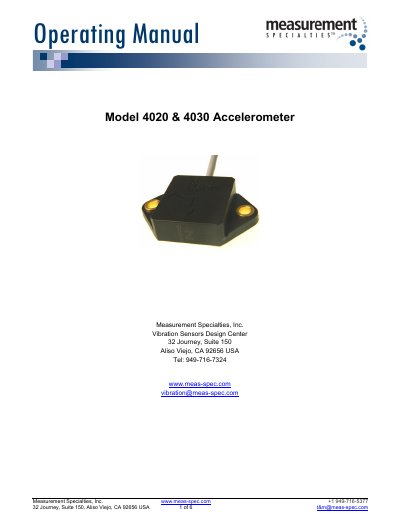
This operating manual covers the Measurement Specialties Model 4020 and 4030 low noise, signal conditioned DC accelerometers, which are packaged in a durable molded housing with an integral cable assembly. The manual describes the products, explains screw mounting and cable routing, gives wiring information for the biaxial 4020 and triaxial 4030, and explains the self-test feature.
The document also includes the warranty statement, receiving inspection and service/return (RMA) procedures, recalibration services, regional contact addresses, and tables of noise floor specifications together with typical frequency response curves for the Model 4030.
| Measurement ranges | ±2 g and ±6 g |
|---|---|
| Nominal bandwidth | 0–200 Hz |
| Operating temperature range | -40 °C to +85 °C |
| Excitation voltage | 5–30 Vdc |
| Full scale output | 0.5 to 4.5 V |
| Output bias | 2.5 Vdc |
| Axis configuration | 4020 dual axis, 4030 triaxial |
| Mounting screw torque | 18 lb-in (2.0 Nm) |
| Sensitivity at ±2 g full scale | 1000 mV/g |
| Passband noise at ±2 g full scale | 600 µVrms |
It is activated by grounding the self-test lead (gray); for normal operation the gray lead floats and is not connected.
The manual specifies 18 lb-in (2.0 Nm) using 2x ¼ or M6 mounting screws, with steel washers and a manual torque wrench.
They are designed to be operated from 5-30 Vdc excitation.