
This document describes the emergency charge method of BYD Battery-Box Pro.
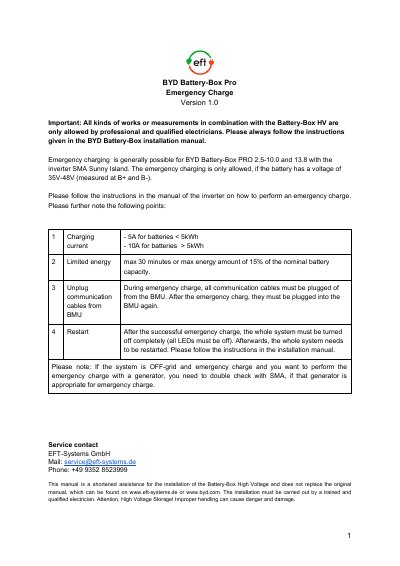
This one-page document describes the emergency charge method for the BYD Battery-Box PRO 2.5-10.0 and 13.8 high voltage battery when combined with the inverter SMA Sunny Island. It states that emergency charging is only permitted when the battery voltage measured at B+ and B- is between 35 V and 48 V, and that the work must be carried out by professional and qualified electricians following the Battery-Box installation manual and the inverter manual.
The guide lists the charging current to use, the energy limit for the charge, the need to unplug all communication cables from the BMU and to plug them back afterwards, and the complete shutdown and restart of the system after a successful charge. It also notes that for an off-grid emergency charge with a generator, suitability of the generator must be checked with SMA, and gives the EFT-Systems service contact.
| Compatible battery models | BYD Battery-Box PRO 2.5-10.0 and 13.8 |
|---|---|
| Compatible inverter | SMA Sunny Island |
| Battery voltage for emergency charge | 35 V - 48 V (measured at B+ and B-) |
| Charging current (batteries < 5 kWh) | 5 A |
| Charging current (batteries > 5 kWh) | 10 A |
| Maximum charge duration | 30 minutes |
| Maximum energy amount | 15% of the nominal battery capacity |
Emergency charging is only allowed if the battery has a voltage of 35 V to 48 V, measured at B+ and B-.
Use 5 A for batteries below 5 kWh and 10 A for batteries above 5 kWh.
All communication cables must be unplugged from the BMU during the charge and plugged back into the BMU afterwards.
The whole system must be turned off completely until all LEDs are off, and then restarted following the installation manual.