
A shipborne device for remote identification and tracking of ships is disclosed, comprising an antenna unit, an inertial navigation unit, a BeiDou RDSS/GNSS unit, and a control unit; the antenna unit is connected to the BeiDou RDSS/GNSS unit, the BeiDou RDSS/GNSS unit and the inertial navigation unit are all connected to the control unit. The advantage is that it effectively solves the problems of terminal reporting abnormalities and ghost ship abnormalities based on the maritime satellite communication system LRIT terminal, realizes normal identification and monitoring of IMO convention ships by LRIT data center, further improves the quality of ship position reporting, and better meets the SOLAS convention related requirements.
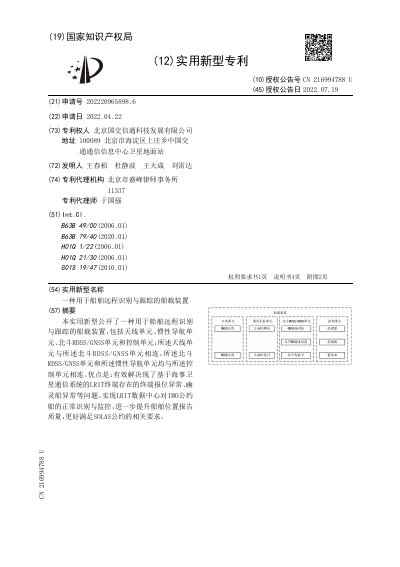
This device enables remote identification and tracking of ships by integrating a BeiDou RDSS/GNSS unit, inertial navigation unit, and control unit. It addresses issues like abnormal reporting and phantom ships in existing LRIT systems, improving compliance with SOLAS requirements.
The device includes GNSS and RDSS antennas, a three-axis gyroscope and accelerometer, and a control unit with processor, memory, and battery. It supports automatic reporting every 6 hours and remote configuration by LRIT centers. This manual is written in Chinese.
| Communication System | BeiDou RDSS/GNSS |
|---|---|
| Navigation Components | Three-axis gyroscope and three-axis accelerometer |
| Reporting Interval | Every 6 hours |
| Data Reported | Vessel ID, position, and time |
It solves issues like abnormal reporting and phantom ships in existing LRIT systems, improving compliance with SOLAS requirements.
It includes an antenna unit, inertial navigation unit, BeiDou RDSS/GNSS unit, and control unit.
It reports every 6 hours automatically.