
This is an installation and maintenance manual for Rotork Fluid Systems SI actuator
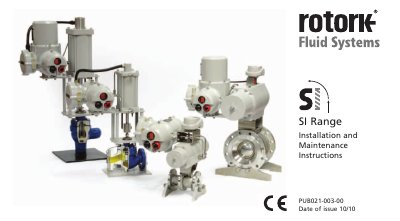
The Rotork Fluid Systems SI Range Installation and Maintenance Instructions (PUB021-003-00, dated 10/10) describes the SI range of valve actuators. It covers electrical local and remote operation, optional manual operation, display and alarm indication, storage, and mounting the actuator onto the valve.
The manual also covers cable connections, commissioning overview, primary and secondary functions, maintenance, monitoring and troubleshooting, weights and measures, nameplate information, hazardous area approvals, and special conditions of safe use. It states that the SI actuator is intended for electric failsafe and modulating valve control and can be commissioned and interrogated without removing electrical covers when using the supplied infra-red Setting Tool.
| Power unit material (SI-1-Q31 to SI-2-Q80) | Aluminium |
|---|---|
| Drive shaft material (Q31-61) | Stainless steel |
| Actuator body material (SI-2-Q100 to Q130) | Carbon steel |
| Piston rod material (SI-1-L and SI-2-L) | Stainless steel |
| Paint finish | Standard 2-pack epoxy silver grey |
| Selector lock padlock shackle | Maximum 6.5 mm |
| Installation altitude for 150–300 VAC remote control/indication supplies | Less than 2000 m |
| Position indication lamps | Red for valve open, yellow for intermediate, green for closed; open and closed colors can be reversed |
| Hazardous gas area ignition temperature | Gases must not have an ignition temperature less than 135 °C unless the nameplate indicates suitability for lower temperatures |
It is described as a solution for electric failsafe and modulating valve control, and the manual covers installation, operation, commissioning and maintenance.
Yes. The document says it can be commissioned and interrogated without removing electrical covers and that it is not necessary to remove the electrical compartment covers to commission it.
A padlock with a maximum 6.5 mm shackle can be used.
In Zone 1 and Zone 2 explosive atmospheres only, and not where gases have an ignition temperature below 135 °C unless the nameplate indicates lower suitability.