
This is a user manual for Concrete Moisture Encounter CME5, which introduces how to use the device to test the moisture content in concrete and cementitious slabs.
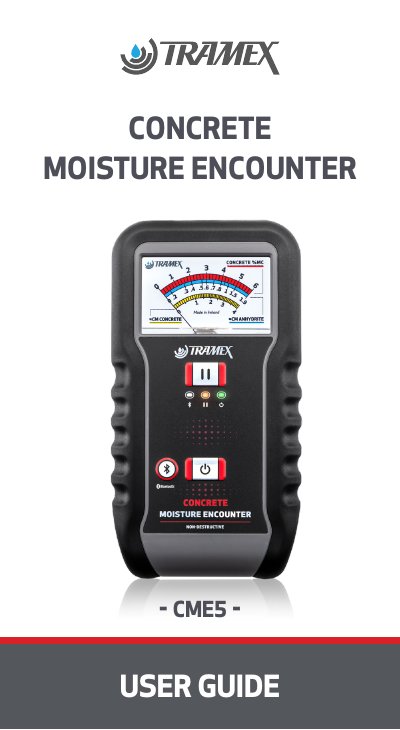
The Tramex Concrete Moisture Encounter CME5 is a non-invasive handheld electronic instrument designed for accurate, instant, and non-destructive testing of moisture content in concrete and cementitious slabs and screeds. It provides readings equivalent to the Carbide Method for both concrete and anhydrite substrates, making it suitable for the flooring, water damage restoration, inspection/surveying, and indoor air quality industries.
| Measurement Method | Non-destructive electrical impedance |
|---|---|
| Concrete Scale Range | 0 - 6 % moisture by mass/weight |
| Anhydrite Scale Type | Equivalent to Carbide Method |
| Automatic Power Off | 5 minutes of inactivity |
| Warranty Period | One year from date of first purchase |
The instrument is designed for the Flooring, Water Damage Restoration, Inspection/Surveying and Indoor Air Quality industries.
Typically a period of at least 3 to 4 weeks per 25mm (1inch) depth of concrete or sand/cement screed needs to be allowed.
Artificial heating or drying equipment should be turned off at least 96 hours before final readings are taken.
It is recommended that calibration should be checked and certified usually on an annual basis by an authorized test provider.