
TB6549FG/PG/HQ is a DC motor driver IC from Toshiba, which uses MOS structure, has low ON resistance, PWM control, thermal protection and other characteristics, and can drive 3.5 A (FG/PG type) or 4.5 A (HQ type) motors.
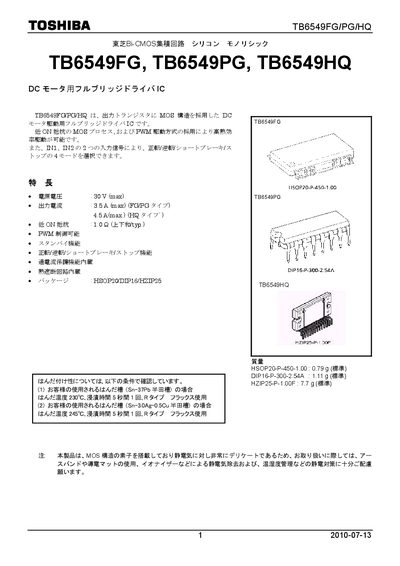
The TB6549FG/PG/HQ series are MOS‑structure full‑bridge driver ICs for DC motors. They offer low ON resistance, PWM control, standby mode, and built‑in over‑current and thermal protection. The device supports four operation modes—forward, reverse, short‑brake and stop—selected via two input signals.
The document includes pin‑out diagrams, block diagrams, absolute maximum ratings, electrical characteristics, and detailed circuit explanations such as the PWM input circuit, standby circuit, internal 5 V regulator, and charge‑pump circuit. Usage notes cover soldering conditions, ESD handling, and thermal design recommendations. This manual is written in Japanese.
| Supply voltage (Vcc) max | 30 V |
|---|---|
| Output current (HQ) max | 4.5 A |
| On‑resistance (typ.) | 1.0 Ω |
| Package types | HSOP20, DIP16, HZIP25 |
| Recommended PWM frequency | ≤ 100 kHz |
The absolute maximum supply voltage (Vcc) is 30 V.
The charge‑pump raises the internal supply to Vcc + 5 V (typ.) and reaches this level in about 2 ms after power‑up.