
This manual provides detailed information on the CANopen DSP 305 module, including specifications, features, and applications.
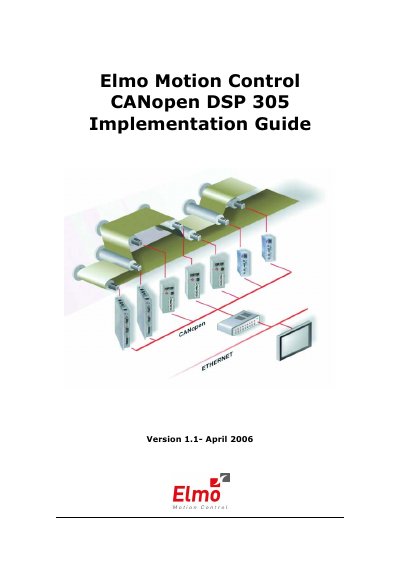
This guide describes the objects and operational modes of the Elmo Motion Control DSP-based motion controller implementation of the CiA DSP 305 protocol. It uses the Elmo Harmonica digital servo drive, part of the SimplIQ family, for examples, and covers Layer Setting Services (LSS) for identifying and configuring unconfigured CANopen devices.
The document explains LSS hardware and operating restrictions, the Configuration and Operation modes, and the four LSS service groups: switch mode, configuration, inquiry, and identification. It also states implementation rules and notes that SimplIQ drives are compliant with CiA's DSP305 protocol for LSS.
| LSS address entry width | 32 bits for each part of the LSS Address |
|---|---|
| COB data capacity | At most 8 bytes of data |
| LSS Master per network | Only one LSS Master |
| Initial baud rate requirement | All nodes must start up with the same initial baud rate |
| LSS address uniqueness | Must be absolutely unique |
LSS stands for Layer Setting Services.
An LSS Master can change the Node ID, the timing parameters of the physical layer (baud rate), and the LSS address.
A network can have only one LSS Master.
Only the switch mode services are available in Operation Mode.