
Industrial pH electrode is a professional pH electrode that can be used in line and in the field. It is mainly used for water quality control, aquariums, beverages, fish hatcheries, food processing, photography, laboratories, paper industry, electroplating industry, quality control, schools and colleges, water quality control and other industries.
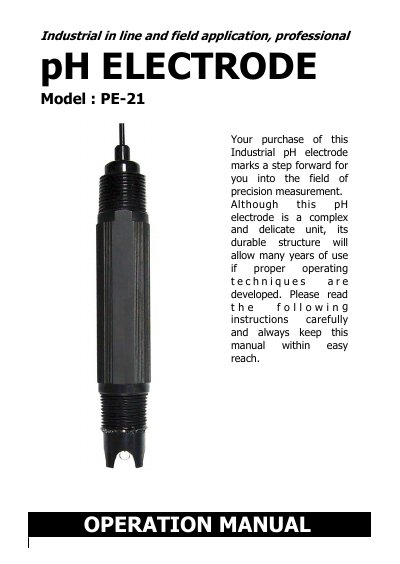
This manual provides detailed instructions for operating, calibrating, cleaning, and reconditioning the Hach PE-21 industrial pH electrode. It includes specifications, storage guidelines, helpful operating techniques, and troubleshooting steps for maintaining electrode performance. The electrode is designed for professional use in various industries including water conditioning, food processing, and laboratories.
The manual emphasizes proper handling to avoid contamination and electrode aging. It includes procedures for storage, calibration with buffers, cleaning methods for different types of coatings, and chemical reconditioning steps for restoring performance. Safety precautions are noted for hazardous chemicals used in reconditioning.
| Measuring Range | 0 to 14 pH |
|---|---|
| Operation Temp. | 0 to 95 °C (32 to 203 °F) |
| Electrode Structure | Combination type |
| Zero Potential for pH Value | 7 + 1 pH |
| Pressure Rating | 6 bar max. |
| Body Material | PPS |
| Connector | BNC |
| Body Thread Size | 3/4" NPT |
| Weight | 250 g/0.55 LB |
| Dimensions | Body length: 177.5 mm, Body Dia.: 26.5 mm, Cable length: 5 meters |
Store the electrode in its soaker bottle filled with pH 4 buffer solution. If the solution is missing, refill it with pH 4 buffer.
Remove the electrode from its soaker bottle, stir it in a rinse solution, shake off excess liquid, stir in the buffer or sample, allow the reading to stabilize, then take the reading. Repeat for each sample or buffer.
Chemically remove the coating using appropriate chemicals. Mechanical cleaning should only be used in extreme cases as it may cause permanent damage.
Try reconditioning the electrode using chemical treatments. If performance is not restored, replace the electrode.