
This user manual covers the operation, calibration, maintenance, and troubleshooting of the Hach LA-EC20 laboratory conductivity meter.
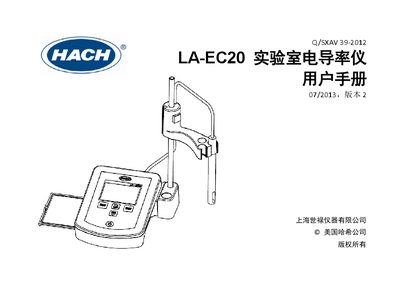
The Hach LA-EC20 is a laboratory instrument designed to measure solution conductivity, Total Dissolved Solids (TDS), and temperature. The device features an LCD display with PET keys for navigation and includes safety warnings regarding electrical shock and chemical exposure during use.
Users can configure settings such as manual temperature compensation, TDS factor, and electrode constant via the menu system. The meter supports both continuous and stable measurement modes and provides error codes to assist in troubleshooting issues like out-of-range measurements or unstable calibration solutions. This manual is written in Chinese.
| Dimensions | 175 x 201 x 62.5 mm |
|---|---|
| Weight | Approximately 760 g |
| Protection Class | IP42 |
| Power Supply | (220 ± 22) V / (50 ± 1) Hz |
| Operating Temperature | 5 to 40 ℃ |
| Conductivity Range | 0.00 μ S/cm ~ 199.9 mS/cm |
| Accuracy Class | Class 0.5 |
The factory default setting for the reference temperature is 25 ℃.
Press and hold the < Conductivity / Down > key to toggle between conductivity and Total Dissolved Solids (TDS) measurements.
Error E-1 indicates a measurement out of range; check and clean the electrode to remove bubbles or contaminants.