
This document introduces the design principle of the liquid-liquid separator, mainly including gravity settling, basic design concepts, operating principles, sizing and selection, etc.
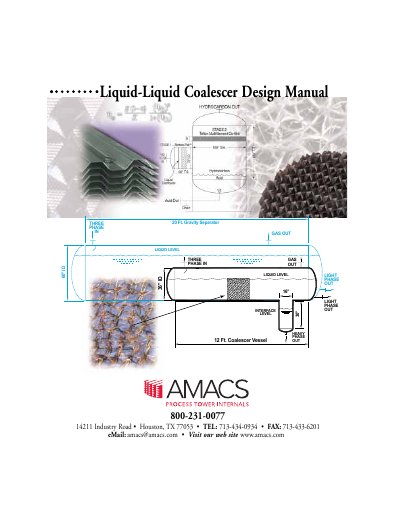
This manual explains how to design liquid-liquid coalescers using gravity settling and coalescing media to separate oil and water. It covers basic principles, sizing methods, and configurations for applications like oil spill cleanup and refinery separation. The document includes equations for terminal settling velocity, droplet size distribution, and practical case studies for upgrading separators and reducing vessel sizes.
The manual also discusses coalescer operation in three steps: droplet capture, coalescence, and gravity separation. It highlights the importance of droplet size, emulsion maturity, and flow conditions for effective separation, with guidance on selecting appropriate media based on droplet size and flow characteristics.
| Terminal Settling Velocity | vt = 1.78 X 10⁻⁶ (∆S.G.) (d)2 / µ |
|---|---|
| Minimum Droplet Size | 75 to 300µm |
| Maximum Stable Droplet Size | 1000µm |
To accelerate the merging of many droplets into larger ones, increasing buoyant forces and reducing separation time downstream.
Between 75 to 300µm, with API Publication 421 using 150µm for oil/water systems.