
Key facts
- Manuals
- 1
- Languages
- EN
- Last added
- 2023-10-17
Featured AMACS manuals
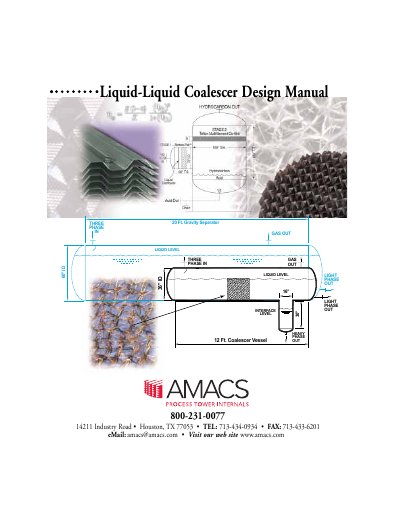
AMACS Liquid-Liquid Coalescer Design Manual
This manual explains how to design liquid-liquid coalescers using gravity settling and coalescing media to separate oil and water. It covers basic principles, sizing methods, and configurations for applications like oil spill cleanup and refinery separation. The document includes equations for terminal settling velocity, droplet size distribution, and practical case studies for upgrading separators and reducing vessel sizes.
The manual also discusses coalescer operation in three steps: droplet capture, coalescence, and gravity separation. It highlights the importance of droplet size, emulsion maturity, and flow conditions for effective separation, with guidance on selecting appropriate media based on droplet size and flow characteristics.
Covers: Introduction · Stokes Settling — Using Gravity · Basic Design Concepts — The Emulsion · Basic Design Concepts — Operating Principles of a Coalescer · Basis for Sizing and Selection · Intra-Media Stokes Settling
Latest AMACS manuals
AMACS Liquid-Liquid Coalescer Design Manual
User Manual 18 pages · 794 KB · ENAMACS manual for designing liquid-liquid coalescers, covering gravity settling, emulsion principles, sizing, and configurations for oil-water separation.
Which document do I need?
User Manual
Day-to-day operation, settings and troubleshooting. Start here if the product is already set up.
Questions answered in AMACS manuals
What is the purpose of a liquid-liquid coalescer?
To accelerate the merging of many droplets into larger ones, increasing buoyant forces and reducing separation time downstream.
What is the typical minimum droplet size for design?
Between 75 to 300µm, with API Publication 421 using 150µm for oil/water systems.