
This manual provides information about how to use the Nitrous Oxide Sensor, including unpacking and connecting, pre-activation and polarization, calibration, measurements and storage and maintenance.
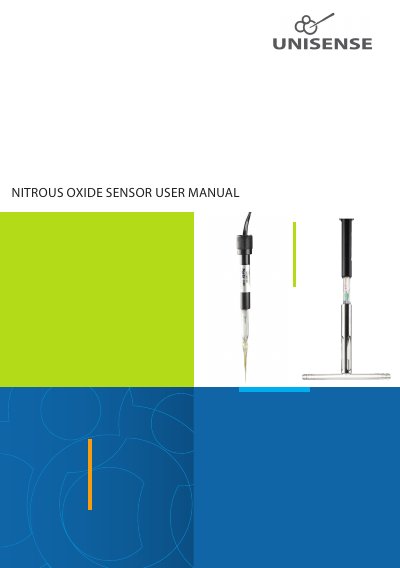
The Unisense N2O sensor is a miniaturized Clark-type nitrous oxide sensor with a guard cathode designed for research applications within environmental sciences. It features an oxygen front guard to prevent interference and connects to a high-sensitivity picoammeter. The manual covers various models including N2O-50, N2O-100, N2O-500, and others with different tip diameters.
| Product Type | Miniaturized Clark-type nitrous oxide sensor |
|---|---|
| Application | Research applications within environmental sciences |
| Warranty Period | 60 days |
| Return Window | 14 days |
| Pre-activation Voltage | -1.3 V |
| Pre-activation Duration | 10-15 minutes |
| Polarization Duration (Microsensor Multimeter) | 30 minutes |
| Polarization Duration (PA2000 amplifier) | 10-15 min |
No, the product is for research use only and is not approved for use in human diagnostic or therapeutic procedures.
The sensor is covered by a 60 days limited warranty.
A voltage of -1.3 V must be applied for 10-15 minutes prior to polarization.
Check for contamination of the cathode surface or loss of cathode material due to excessive vibration; replace the microsensor if these are the causes.