
xt is a series of commands for analyzing panel data, providing commands for describing and statistically analyzing panel data
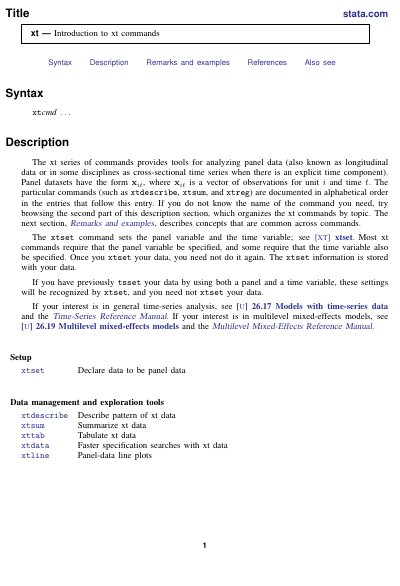
The document provides an introduction to the xt series of commands in Stata, which are designed for analyzing panel data (also known as longitudinal data). It explains that panel datasets consist of observations for units over time and details the requirement to use the xtset command to declare the panel and time variables before using other xt commands.
The manual categorizes the available commands into several functional groups, including data management and exploration tools (such as xtdescribe and xtsum), linear regression estimators (like xtreg and xtgls), unit-root tests, dynamic panel-data estimators, and estimators for censored, binary, ordinal, and count data outcomes.
The xt series of commands provides tools for analyzing panel data, which is also known as longitudinal data or cross-sectional time series when there is an explicit time component.
The xtset command sets the panel variable and the time variable, and this information is stored with the data so it does not need to be specified again.
Panel datasets in the long form are stored as a sequence of observations on (i,t,x), where xit is a vector of observations for unit i and time t.