
This document describes the technical principle of Primary-Secondary pumping, which was proposed by Bell and Gosset in 1954.
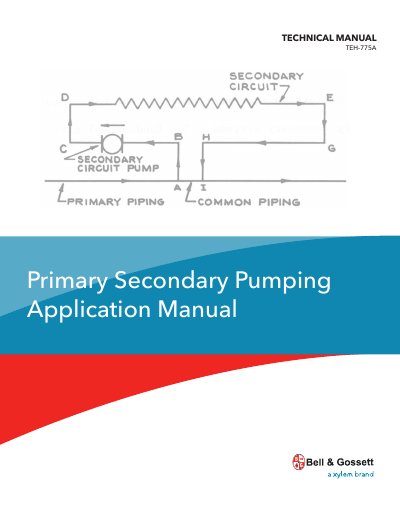
This technical manual covers the basics of primary-secondary pumping and control circuits, explaining how interconnected piping systems operate based on pressure drops. It details the B&G Monoflo circuit, which uses a fixed orifice in common piping to ensure flow in the radiation circuit while maintaining hydraulic isolation from the main circuit.
The document provides design rules and definitions for system components, such as the location of the secondary circuit pump and the configuration of the cross-over bridge. It discusses pipe sizing, flow characteristics, and specific applications like freeze protection for outside air handling coils and expanding existing distribution piping capacity.
| Common piping maximum length | approximately two feet |
|---|---|
| Cross-over bridge minimum velocity | 2 feet per second |
When two piping circuits are interconnected, flow in one will cause flow in the other to a degree depending upon the pressure drop in the piping common to both.
The secondary pump should always discharge into the secondary circuit to increase secondary circuit pressure over the cross-over bridge.
Common piping can vary in length from a short nipple to approximately two feet to ensure minimum pressure drop.