
This document is the user manual for MOTORTRONICS TM Solid State AC Motor Control, which describes the installation, motor overload protection, connections, programming, and other aspects of the product.
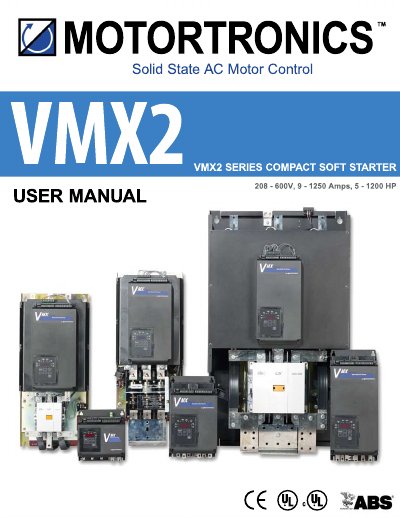
The VMX2 Series is a digitally programmable solid-state reduced voltage soft starter designed for three-phase AC induction motors. It features a six-SCR design with voltage and current ramp control, anti-oscillation circuits, and programmable auxiliary contacts for smooth load acceleration and reduced inrush current.
| Type of Load | Three-phase AC induction motors |
|---|---|
| AC Supply Voltage | Universal, 208 - 600VAC ±10%, 50/60 Hz |
| Power Ratings | 9 - 1250 Amps, 7.5 - 1000 HP @ 460V |
| Overload Rating | 500% - 60 seconds |
| Control Power | 120VAC (customer supplied), 240VAC optional |
| SCR Firing Angle Detection | 6 pulse Independent Locked Phase Tracking |
| SCR PIV Ratings | 1600V |
| Ambient Condition Design | 0° to 40°C (32° to 122°F) |
| Approvals | UL Listed, Canadian UL (cUL) Listed, CE Approved |
The unit overload rating is 500% of the motor FLA for up to 60 seconds.
The unit features programmable Voltage Ramp (VR) or closed loop Current Ramp (CR).
Yes, integral control is included, but the contactor can also be externally controlled.