
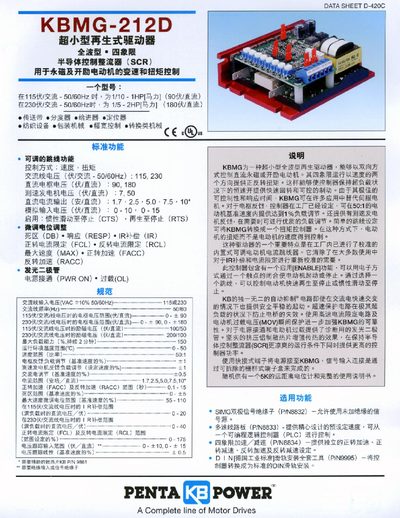
The KBMG‑212D ultra‑small regenerative drive provides full‑wave, four‑quadrant operation for permanent‑magnet and separately‑excited DC motors. It delivers both speed and torque control and includes features such as inertia slide‑to‑stop (CTS) and regeneration‑to‑stop (RTS) enable functions.
The unit accepts 115 V or 230 V AC input (50/60 Hz) and can deliver 0.1‑1 HP at 115 V (90 V DC) or 0.2‑2 HP at 230 V (180 V DC). It offers configurable analog inputs (0‑10 V or 0‑15 V) and a range of selectable DC output currents up to 10 A. Optional accessories include insulated signal isolators, multi‑speed PCB, and DIN‑rail mounting kits. This manual is written in Chinese.
| Input AC line voltage | 115 V, 230 V (50/60 Hz) |
|---|---|
| DC armature voltage | 90 V, 180 V |
| Control mode | Speed, Torque |
| DC output current (selectable) | 1.7 A, 2.5 A, 5.0 A, 7.5 A, 10 A |
| Analog input voltage range | 0‑10 V or 0‑15 V |
| Enable functions | Inertia slide to stop (CTS), Regeneration to stop (RTS) |
| Power rating (115 V) | 0.1‑1 HP (90 V DC) |
| Power rating (230 V) | 0.2‑2 HP (180 V DC) |
| Maximum load capacity | 150 % for 2 minutes |
It accepts either 115 V or 230 V AC at 50/60 Hz.
It can control permanent‑magnet and separately‑excited DC motors.
The controller has an ENABLE function that starts or stops the motor via a contact closure, with options for inertia slide‑to‑stop (CTS) or regeneration‑to‑stop (RTS).
The drive accepts analog inputs of 0‑10 V or 0‑15 V.