
This document provides general information about the BMW F25 model, including the use of symbols and important safety notes, as well as information about information status and national market versions.
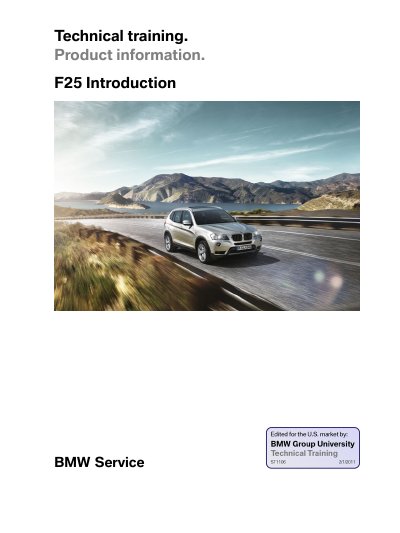
This document serves as technical training material for the BMW F25, which is the chassis code for the second-generation BMW X3. It was introduced to the US market in January 2011 and is available in xDrive28i and xDrive35i models at launch.
The guide provides detailed information on vehicle dimensions comparing the new model to its predecessor (E83), bodyshell construction utilizing high-strength multi-phase and press-hardened steels, corrosion protection methods, and crash testing research.
| Vehicle length | 4648 mm |
|---|---|
| Wheelbase | 2810 mm |
| Vehicle height, empty | 1661 mm |
| Luggage compartment capacity | 550 liters |
| Curb weight (xDrive28i) | 4112 lbs |
| Curb weight (xDrive35i) | 4222 lbs |
| Multi-phase steels proportion | 14% of bodyshell weight |
The F25 was introduced to the US market in January 2011.
At launch, the new X3 is available in the xDrive28i and xDrive35i models.
The body is comprised mainly of strong, lightweight materials including higher-strength multi-phase steels and super-strength press-hardened steels.