
This document is the operating manual for the intelligent self-tuning PID control instrument, which introduces the functions and usage of the instrument.
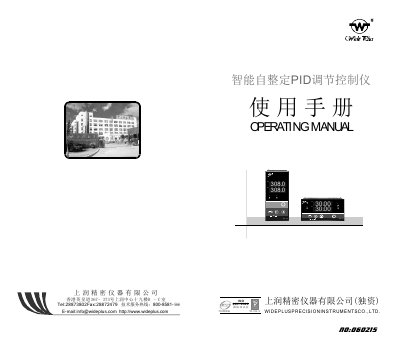
The WIDEPLUS WP-80 Intelligent Self-tuning PID Controller is a precision instrument designed for automatic control systems. It utilizes advanced microprocessor technology to automatically calculate optimal adjustment parameters based on the controlled object. The device features dual-screen digital and light bar displays, multiple input signal switching capabilities, and various serial communication interfaces for multi-machine communication. This manual is written in Chinese.
| Measurement Accuracy (Digital) | +0.5%FS+t1(digits) |
|---|---|
| Display Resolution | +1 digit / +1 line |
| Measurement Range (Digital) | -1999 to 9999 |
| Output Relay Contact Capacity (AC) | 220V/7.3A (resistive load) |
| Output SCR Trigger Signal | 400V/0.5A |
The product comes with a free warranty within 18 months of manufacture, and paid service after that.
Under normal conditions, no special maintenance is required; users should only pay attention to moisture and dust prevention.
Yes, changing the input type requires setting the secondary parameters of the instrument to match the desired scale number.