
The CM3120 is an IO-Link master physical layer dedicated to the industrial market. It includes two fully-featured IO-Link channels, which can work in three different operation modes. This circuit integrates an IO-Link frame handler fully compliant with the IO-Link v1.1 specification, and which implements most of the IO-Link communication tasks. The frame handler significantly decreases load of the master microcontroller. The CM3120 also provides several protection and monitoring mechanisms such as overcurrent, overvoltage, and overtemperature.
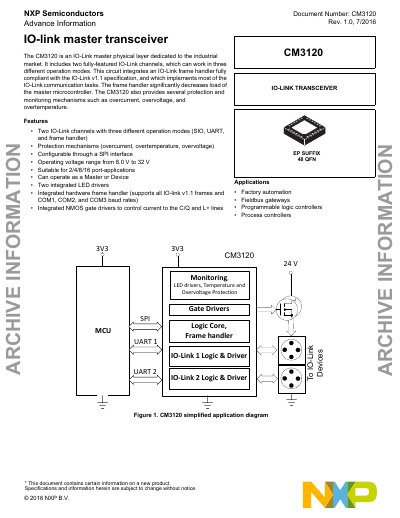
The CM3120 is a dedicated IO-Link master transceiver designed for the industrial market. It integrates a fully compliant IO-Link v1.1 frame handler to reduce microcontroller load and includes protection mechanisms such as overcurrent, overvoltage, and overtemperature monitoring.
The device features two IO-Link channels that support three operation modes: SIO, UART, and frame handler. It is configurable via an SPI interface and can operate as either a Master or Device. The chip also integrates NMOS gate drivers for controlling current to the C/Q and L+ lines.
| Operating voltage range (VCC) | 8.0 V to 32 V |
|---|---|
| Number of IO-Link channels | Two |
| Operating temperature range | -40 °C to 85 °C |
| SPI Clock Frequency | 1.0 MHz to 20 MHz |
The device supports three different operation modes: SIO, UART, and frame handler.
Yes, it can operate as either a Master or Device.