
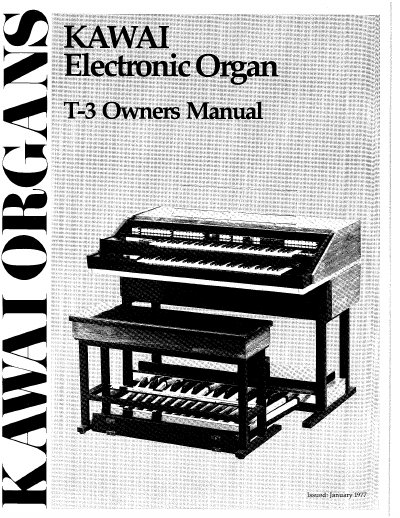
The Kawai T-3 is an electronic organ featuring two groups of nine Tibia drawbars for the upper manual and one group for the lower manual, allowing for flexible tone registration across flute, reed, string, and diapason families. The instrument includes a Synthe-Sound division with controls for Instrumental Percussion, Orchestral Solo Voices, and a Synthesizer section, all adjustable via drawbars for volume, filters, and effects.
The manual details the operation of pedal drawbars, attack percussions, and reverberation effects. It also provides instructions for connecting the organ to the Model 147 Leslie tone cabinet and optional stationary amplifiers, along with a list of technical specifications for keyboards and controls.
| Upper Manual Keys | 61 Keys |
|---|---|
| Lower Manual Keys | 61 Keys |
| Pedal Keys | 25 Keys |
| Compatible Tone Cabinet | Model 147 |
| Tuning Range | + 60 cents |
The four traditional families of organ voices are flutes (also called tibias), reeds, strings, and diapasons.
Two drawbars controlling tibia voices at 16' and 8' provide the tonalities for the pedal division.