
This document introduces the features of STMUX1800E, including low RON, VCC operating range, ESD protection, low power mode, channel capacitance, switching time speed, propagation delay, crosstalk, bit-to-bit skew, bandwidth, package, application scenarios, etc.
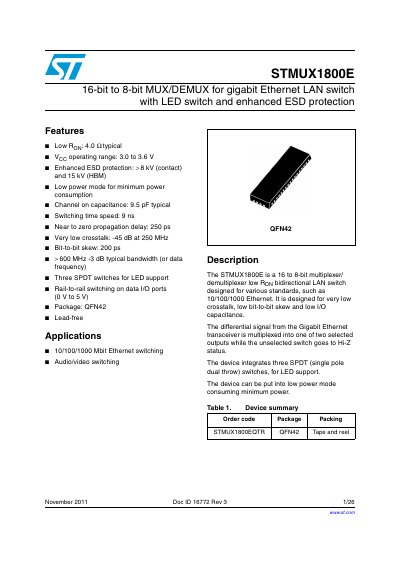
The STMUX1800E is a 16-bit to 8-bit multiplexer/demultiplexer designed for 10/100/1000 Ethernet switching applications. It features low on-resistance (4.0 Ω typical), enhanced ESD protection (>8 kV contact, >15 kV HBM), and low power consumption modes. The device integrates three SPDT switches for LED support and offers rail-to-rail switching on data I/O ports.
| On-resistance (Ron) | 4.0 Ω typical |
|---|---|
| Supply voltage range | 3.0 to 3.6 V |
| ESD protection (Contact) | > 8 kV |
| ESD protection (HBM) | > 15 kV |
| Channel on capacitance | 9.5 pF typical |
| Switching time | 9 ns |
| Propagation delay | 250 ps |
| Crosstalk | -45 dB at 250 MHz |
| Bit-to-bit skew | 200 ps |
| Bandwidth | >600 MHz -3 dB typical |
| Package | QFN42 |
| Operating temperature | -40 to 85 °C |
The typical on-resistance is 4.0 Ω.
The device operates with a supply voltage between 3.0 V and 3.6 V.
Yes, it integrates three SPDT switches for LED support.
The device is available in a QFN42 package.