
The 74LVX594 is a low voltage CMOS 8 bit shift register with output register fabricated with sub-micron silicon gate and double-layer metal wiring C2MOS technology. It is ideal for low power, battery operated and low noise 3.3V applications. This device contains an 8-bit serial-in, parallel-out shift register that feeds an 8-bit D-type storage register. Separate clocks and direct overriding clear (SCLR, RCLR) are provided for both the shift register and the storage register. A serial (QH’) output is provided for cascading purposes. Both the shift register and storage register use positive-edge triggered clocks. If the clocks are connected together, the shift register state will always be one clock pulse ahead of the storage register. Power down protection is provided on all inputs and 0 to 7V can be accepted on inputs with no regard to the supply voltage. This device can be used to interface 5V to 3V system. It combines high speed performance with the true low power, making it ideal for a wide range of applications.
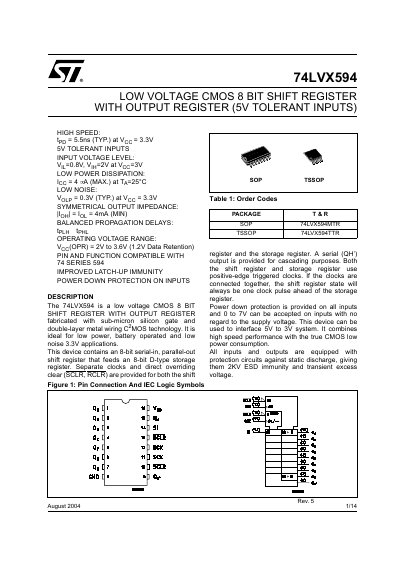
This datasheet covers the STMicroelectronics 74LVX594, a low voltage CMOS 8-bit shift register with an output register, fabricated with sub-micron silicon gate and double-layer metal wiring C2MOS technology. The device contains an 8-bit serial-in, parallel-out shift register that feeds an 8-bit D-type storage register, with separate clocks and direct overriding clear inputs (SCLR, RCLR) for both registers. A serial output (QH') is provided for cascading, and both registers use positive-edge triggered clocks. Power down protection is provided on all inputs, and 0 to 7V can be accepted on inputs regardless of supply voltage, allowing the device to interface 5V to 3V systems.
The document gives pin connections and logic symbols, pin and truth tables, a logic diagram and timing chart, absolute maximum ratings, recommended operating conditions, DC and AC electrical characteristics, capacitive characteristics, test circuits and waveforms. Mechanical data for the SO-16 and TSSOP16 packages and their tape & reel packing, order codes (74LVX594MTR in SOP, 74LVX594TTR in TSSOP) and a revision history are also included.
| Operating Voltage Range | VCC(OPR) = 2V to 3.6V (1.2V data retention) |
|---|---|
| Propagation Delay | tPD = 5.5 ns (typ.) at VCC = 3.3V |
| Quiescent Supply Current | ICC = 4 µA (max.) at TA = 25°C |
| Output Drive | |IOH| = IOL = 4 mA (min.) |
| Input Voltage | 0 to 5.5 V |
| Input Voltage Levels at VCC = 3V | VIL = 0.8V, VIH = 2V |
| ESD Immunity | 2KV |
| Operating Temperature | -55 to 125 °C |
| Packages and Order Codes | SOP 74LVX594MTR; TSSOP 74LVX594TTR |
| Supply Voltage (absolute maximum) | -0.5 to +7.0 V |
It is a low voltage CMOS 8-bit shift register with an output register, containing an 8-bit serial-in, parallel-out shift register that feeds an 8-bit D-type storage register.
Yes. Power down protection is provided on all inputs and 0 to 7V can be accepted on inputs with no regard to the supply voltage.
Yes, separate clocks and direct overriding clear inputs (SCLR, RCLR) are provided for both the shift register and the storage register.
Yes, a serial output (QH') is provided for cascading purposes.