
This document describes the features and characteristics of the STPS30150C high voltage power Schottky rectifier, including high junction temperature capability, good trade-off between leakage current and forward voltage drop, low leakage current, and avalanche capability.
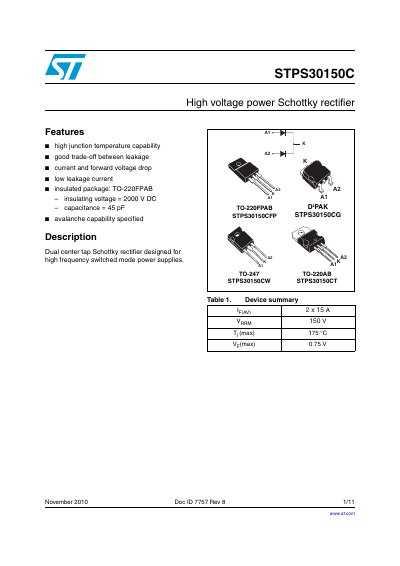
This document provides a comprehensive technical overview of the STPS30150C, a dual center tap Schottky rectifier designed for high frequency switched mode power supplies. Key features include a high junction temperature capability of 175°C, low leakage current, and an insulated TO-220FPAB package with an insulating voltage of 2000 V DC.
The datasheet details absolute maximum ratings, static electrical characteristics, and thermal resistance values for various package types including TO-220FPAB, TO-220AB, TO-247, and D2PAK. It also includes ordering information for different package variants and revision history for the document.
| Repetitive peak reverse voltage | 150 V |
|---|---|
| Forward rms current | 30 A |
| Maximum operating junction temperature | 175 °C |
| Insulating voltage (TO-220FPAB) | 2000 V DC |
| Capacitance (TO-220FPAB) | 45 pF |
The maximum operating junction temperature is 175 °C.
The repetitive peak reverse voltage is 150 V.