
The STA020D is a monolithic CMOS device which encodes and transmits audio data according to the AES/EBU, IEC 958, S/PDIF, & EIAJ CP-340 inter- face standards. It supports 96kHz sample rate op- eration
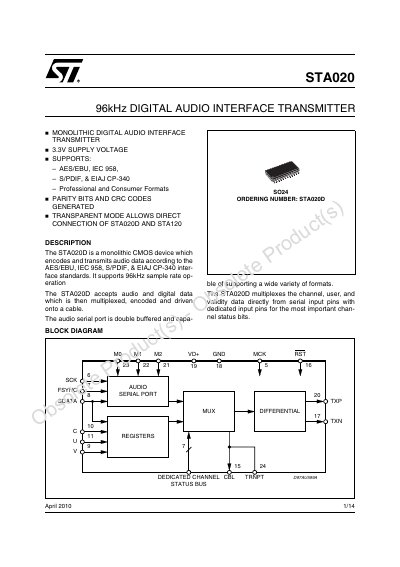
The STA020D is a monolithic CMOS device that encodes and transmits audio data according to professional and consumer digital audio interface standards. It supports sample rates up to 96kHz and includes features such as parity bit generation, CRC code generation, and transparent mode for direct connection with other ST devices.
The device accepts audio and control data through a serial port configured in one of seven formats, multiplexes the data internally, and drives it onto a transmission line via differential RS422-compatible line drivers. It operates on a 3.3V supply voltage.
| Supply Voltage | 3.3V (Nominal) |
|---|---|
| Operating Temperature | -20 to +85 °C |
| Storage Temperature | -40 to 150 °C |
| Supported Standards | AES/EBU, IEC 958, S/PDIF, EIAJ CP-340 |
| Maximum Master Clock Frequency | 26 MHz |
The nominal DC power supply voltage is +3.3V.
The device supports AES/EBU, IEC 958, S/PDIF, and EIAJ CP-340.
Yes, transparent mode allows direct connection of the STA020D and STA120.