
TS861, TS862, TS864 are rail-to-rail micropower BiCMOS comparators from Renesas, featuring ultra low current consumption, rail to rail CMOS inputs, push pull outputs, supply operation from 2.7 to 10 V, low propagation delay, 2 kV ESD protection and A class latch-up immunity. It is suitable for battery-powered systems, portable communication systems, smoke/gas/fire detectors, portable computers and more.
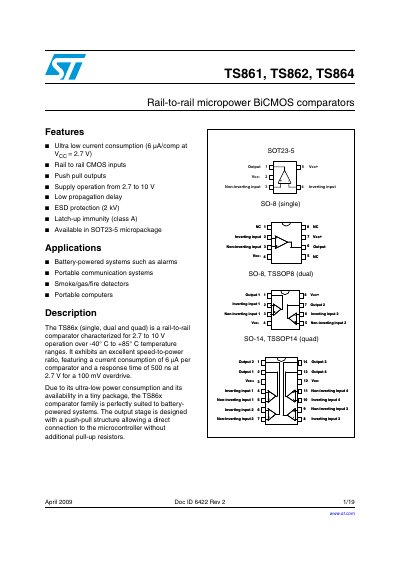
The document describes the TS861 (single), TS862 (dual), and TS864 (quad) family of rail-to-rail micropower BiCMOS comparators. These devices are characterized for operation over a supply voltage range of 2.7 to 10 V and a temperature range of -40° C to +85° C.
| Supply voltage range | 2.7 to 10 V |
|---|---|
| Current consumption (typical) | 6 µA/comp |
| Input offset voltage (Typ.) | 3 mV |
| Propagation delay (typical) | 0.5 µs |
| ESD protection rating | 2 kV |
The typical current consumption is 6 µA per comparator at a supply voltage of 2.7 V.
The devices are available in SOT23-5, SO-8, TSSOP8 (dual), and TSSOP (quad) packages.
Yes, the push-pull output stage allows for a direct connection to the microcontroller without additional pull-up resistors.