
The ST26C32AB is a ST company's CMOS quad 3-state differential line receiver. It features low power consumption, ±0.2V sensitivity, typical propagation delay of 19ns, typical input hysteresis of 60mV, meets EIA standard RS-422, RS-423 requirements, and can be used to connect system buses.
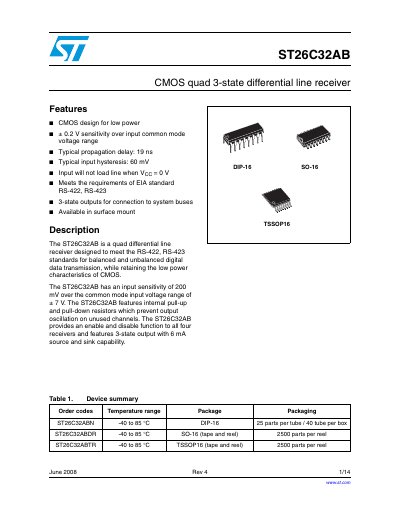
The ST26C32AB is a quad differential line receiver designed for balanced and unbalanced digital data transmission. It features an input sensitivity of 200 mV over the common mode input voltage range of +7 V, ensuring reliable signal reception in noisy environments.
The device includes internal pull-up and pull-down resistors to prevent output oscillation on unused channels and provides a 3-state output with enable/disable functions for all four receivers. It is available in DIP-16, SO-16, and TSSOP16 packages.
| Supply voltage (Recommended) | 4.5 to 5.5 V |
|---|---|
| Operating temperature range | -40 to +85 °C |
| Input sensitivity | 200 mV |
| Propagation delay (Typical) | 19 ns |
| Input hysteresis (Typical) | 60 mV |
| Output current capability | 6 mA source and sink |
The device meets the requirements of EIA standard RS-422 and RS-423.
The ST26C32AB is available in DIP-16, SO-16 (tape and reel), and TSSOP 16 packages.
The absolute maximum rating for the supply voltage is 7 V.