
ST232B and ST232C are 5V powered multi-channel RS-232 drivers and receivers. The features include a supply voltage range of 4.5V to 5.5V, a supply current of 5mA with no load, a transmitter output voltage swing of ±7.8V, controlled output slew rate, a receiver input voltage range of ±30V, a data rate of 220kbps, and an operating temperature range of -40°C to 85°C or 0°C to 70°C.
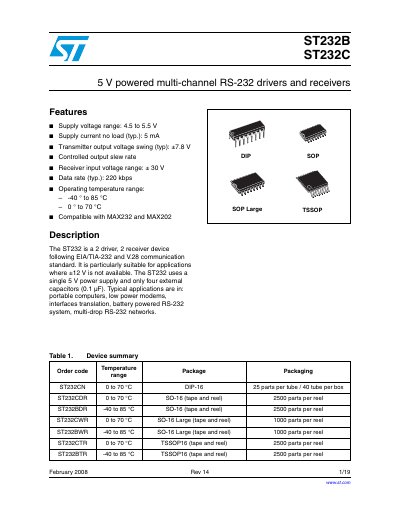
The ST232B and ST232C are 2-driver, 2-receiver devices following the EIA/TIA-232 and V.28 communication standards. They are designed for applications where ±12V is not available, utilizing a single 5V power supply and requiring only four external capacitors (0.1µF). Typical applications include portable computers, low power modems, interface translation, battery-powered RS-232 systems, and multi-drop RS-232 networks.
| Supply voltage range | 4.5 to 5.5 V |
|---|---|
| Supply current no load (typ.) | 5 mA |
| Transmitter output voltage swing (typ.) | ±7.8 V |
| Receiver input voltage range | ± 30 V |
| Data rate (typ.) | 220 kbps |
| Operating temperature range | -40 to 85 °C |
| Compatible with | MAX232 and MAX202 |
The typical supply current with no load is 5 mA.
The typical data rate is 220 kbps.
Yes, the ST232 is compatible with MAX232 and MAX202.