
This document presents the principles of capacitive sensing and charge transfer used in STMicroelectronics STM8T and STM8TS capacitive sensors. All devices can be configured in touch or proximity sensing.
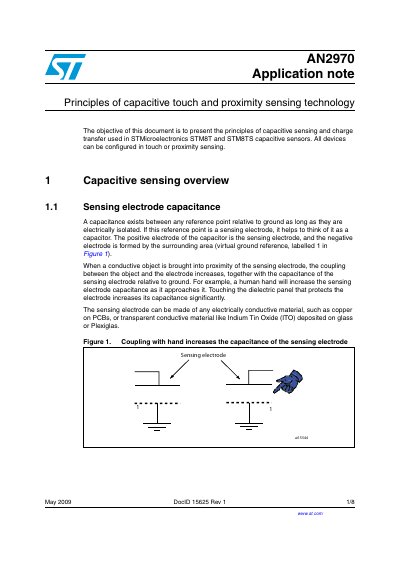
This document presents the principles of capacitive sensing and charge transfer used in STMicroelectronics STM8T and STM8TS capacitive sensors. These devices can be configured for both touch and proximity sensing applications. The text details how sensing electrode capacitance changes when a conductive object approaches or touches the electrode.
The document describes the charge-transfer sequence where charge from the sensing electrode is transferred to a reference capacitor (Cg) until a threshold voltage is reached. It covers factors influencing the transfer rate, such as the internal oscillator frequency and serial resistors, and provides guidelines for selecting the Cg capacitor based on sensing electrode size and power supply type.
| Supported devices | STM8T and STM8TS |
|---|---|
| Cg capacitor range | 10 nF to 1 uF |
| Recommended transfer rate | 100 kHz to 150 kHz |
| Serial resistor Rx value | 1 to 2kQ |
| Cg capacitance ratio | 1000 to 100,000 times bigger than Cy |
To present the principles of capacitive sensing and charge transfer used in STM8T and STM8TS capacitive sensors.
Yes, all devices can be configured in touch or proximity sensing.
It increases the sensing electrode capacitance by a few picoFarads, which has an instant negative influence on the sensitivity of the system.