
This application note describes how to achieve optimum ADC accuracy on the STM32F10xxx. It first introduces various factors related to ADC design, such as external hardware design parameters and different types of ADC error sources. Then, some design recommendations are given, and how to reduce errors in hardware is proposed.
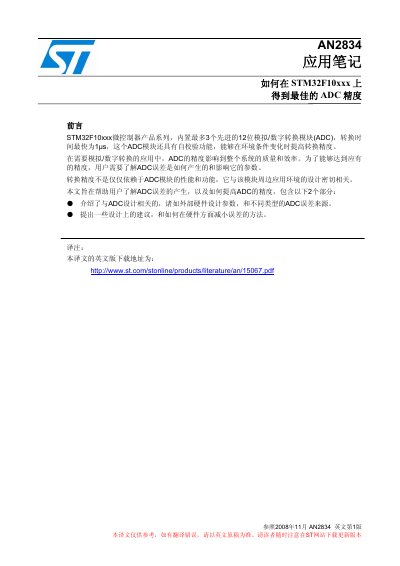
This document is an application note titled 'How to get the best ADC accuracy on STM32F10xxx'. It is a Chinese translation of the English version AN2834, originally published in November 2008. The text serves as a technical guide for users of the STM32F10xxx microcontroller series, which features up to three advanced 12-bit ADC modules.
The document is divided into two main parts. The first part details various types of ADC errors, including those intrinsic to the ADC module (such as offset, gain, differential linearity, integral linearity, and total unadjusted errors) and those related to the external environment (such as power supply noise, signal noise, impedance effects, and temperature). The second part offers specific design suggestions and hardware methods to minimize these errors and optimize ADC performance. This manual is written in Chinese.
| ADC Resolution | 12-bit |
|---|---|
| ADC Modules | Up to 3 |
The STM32F10xxx microcontroller series features up to three advanced 12-bit analog-to-digital conversion modules.
Yes, the ADC module includes a self-calibration function that can improve conversion accuracy when environmental conditions change.