
The iP 900 is a new member of Lab.gruppen’s Iron Power (iP) family of compact and versatile professional power amplifiers. Featuring classic toroidal iron transformers, the iP 900 is ideal for use in both installations and cost-effective live sound systems.
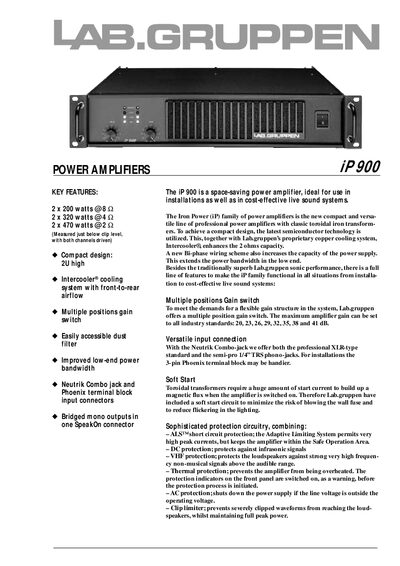
The iP 900 is a compact 2U high power amplifier designed for installations and cost‑effective live‑sound systems. It delivers up to 470 W per channel at 2 Ω, includes a proprietary Intercooler® cooling system, and offers a multiple‑position gain switch with eight selectable gain levels.
The manual lists detailed electrical specifications, input options (Neutrik Combo XLR, 3‑pin Phoenix terminal block, 1/4" jack), and a comprehensive protection suite covering short‑circuit, DC, VHF, thermal, AC, and clip‑limiting functions. Physical dimensions, weight, and regulatory approvals are also provided.
| Output Power (8 Ω per channel, EIA) | 200 W |
|---|---|
| Output Power (4 Ω per channel, EIA) | 320 W |
| Output Power (2 Ω per channel, EIA) | 470 W |
| Gain Settings | 20, 23, 26, 29, 32, 35, 38, 41 dB |
| Input Impedance | 20 kΩ |
| Net Dimensions | 483 mm W × 88 mm H × 325 mm D |
The iP 900 delivers 200 W per channel measured at 1 kHz and 1 % THD (EIA).
The amplifier offers eight selectable gain positions ranging from 20 dB to 41 dB.
It includes Neutrik Combo XLR/1/4" jack inputs and a 3‑pin Phoenix terminal block.