
This application note explains how to develop an application using either Visual Basic or C/C++ language to drive the DEMO-CR95HF-A demonstration board from a host computer. The DEMO-CR95HF-A is a demonstration kit which allows to evaluate the performance of STMicroelectronics CR95HF 13.56 MHz multiprotocol contactless transceiver. It includes a ready-to-use board to interface with the CR95HF host PC demonstration software through a USB interface. The DEMO-CR95HF-A board is powered through the USB port and no external power supply is required. It is made up of a CR95HF contactless transceiver, a 48 x 34 mm 13.56 MHz inductive etched antenna and its associated tuning components. The CR95HF communicates with the STM32F103CB 32-bit core MCU via the SPI bus. A dynamic link library (DLL) file is used by the host computer to manage several functions and communicate with the STM32 MCU and the CR95HF IC. It is included in the demo-cr95hf-a_dev_appli.zip version 2 (Visual Basic 6 and C/C++ source code examples) which can be downloaded from http://www.st.com. An executable with a simple user interface is also available for both Visual Basic and C/C++ projects.
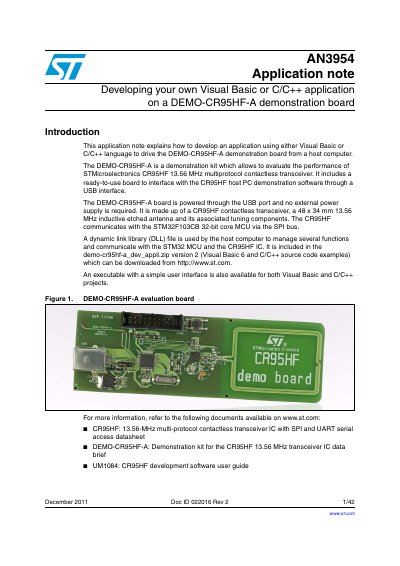
The document describes the development of applications using Visual Basic or C/C++ to control the DEMO-CR95HF-A demonstration board. This kit allows users to evaluate the performance of the STMicroelectronics CR95HF 13.56 MHz multiprotocol contactless transceiver via a USB interface.
The guide details the usage of a specific Dynamic Link Library (DLL) file, CR95HF.dll, which manages communication between the host computer and the board's STM32 MCU and CR95HF IC. It provides function descriptions for checking installation, connecting to the USB port, communicating with the microcontroller, controlling the transceiver IC, and interacting with RF tags.
The application note explains how to develop an application using either Visual Basic or C/C++ language.
No, the board is powered through the USB port and no external power supply is required.
No particular USB driver is needed; the standard HID USB driver included in Windows operating systems is used.