
STMicroelectronics AN3250 M24LR64-R Multi-Bank Application Note

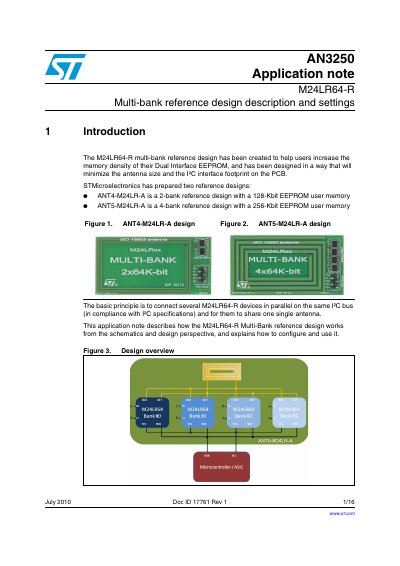
This application note describes how the M24LR64-R Multi-Bank reference design works from the schematics and design perspective, and explains how to configure and use it

STMicroelectronics AN3250 M24LR64-R Multi-Bank Application Note - cover page
Brand
STMicroelectronics
Category
Electronic Original
Document type
Application Note
Language
English
Pages
16
File format
PDF
File size
598 KB
Published
06 August, 2012
Updated
01 October, 2023
MD5 checksum
A993C46057047C2C7B9AA32ACDB74291

About this manual

The document describes the M24LR64-R multi-bank reference design, which allows users to increase memory density by connecting several M24LR64-R devices in parallel on the same I2C bus and sharing a single antenna. STMicroelectronics provides two specific reference designs: ANT4-M24LR-A (2-bank, 128-Kbit) and ANT5-M24LR-A (4-bank, 256-Kbit).

What's inside

  • Introduction
  • Designing an M24LR64-R multi-bank application
  • Accessing several EEPROMs on the same I2C bus
  • Connecting several M24LR64-R devices on the same inductive antenna
  • Setting up a Multi-Bank application
  • Basic principle
  • Microcontroller's perspective
  • RF reader's perspective
  • Overall perspective
  • Setting up the Multi-Bank design

Specifications

Operating Frequency13.56 MHz
Standard ComplianceISO/IEC 15693
Memory Capacity (Single Device)64-Kbit
Memory Capacity (4-Bank Design)256-Kbit
Max Devices per Bus4

Frequently asked questions

What is the purpose of the M24LR64-R multi-bank reference design?

It helps users increase the memory density of their Dual Interface EEPROM by connecting several devices in parallel.

How many M24LR64-R devices can be accessed on the same I2C bus?

Up to four devices can be accessed by using the EO and E1 bits of the Device Select code.

What is the equivalent tuning capacitance for a 4-bank design?

The equivalent tuning capacitance is 4 times that of a single M24LR64-R device.

Download PDF (598 KB)

More STMicroelectronics Manuals


View all STMicroelectronics manuals →