
This application note describes the selection of bootstrap components, including bootstrap capacitors, bootstrap diodes, bootstrap resistors, bootstrap transformers, and bootstrap transistors.
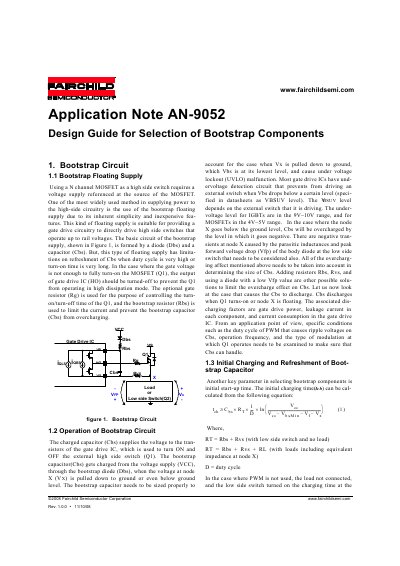
The document explains the operation of bootstrap floating supplies used to provide power to high-side switch circuitry. It details the limitations regarding capacitor refreshment at high duty cycles and long turn-on times, as well as issues with overcharging due to negative transients.
The guide outlines methods for calculating the initial charging time and determining the minimum required capacitance based on gate charge, leakage currents, and operating conditions. It includes specific selection criteria for bootstrap capacitors and diodes, along with two detailed calculation examples using Fairchild FAN708x series gate drive ICs.
| Undervoltage Lockout Level (IGBTs) | 9V~10V range |
|---|---|
| Undervoltage Lockout Level (MOSFETs) | 4V~5V range |
The bootstrap capacitor discharges when the high-side switch turns on or when node X is floating.
Overcharging can be mitigated by adding resistors (Rbs, Rvs) and using a diode with a low forward voltage drop.