
This paper examines the VoIP hardware requirements from several perspectives and the trade-offs that must be considered to choose an effective approach
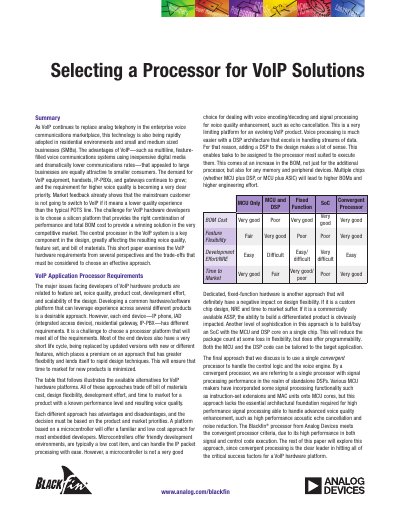
This document examines the trade-offs between different processor platforms for VoIP hardware, including microcontrollers, DSPs, and SoCs. It argues that a convergent processor architecture is the most effective approach for balancing performance, flexibility, and cost. The text specifically identifies the Blackfin processor from Analog Devices as meeting these criteria due to its high performance in both signal and control code execution.
| Core Speed | Up to 400 MHz |
|---|---|
| L1 On-chip Memory | 116 kB |
| Ethernet Interface | 10/100 Ethernet MAC |
| GPIO Count | Up to 40 GPIOs |
| Security Memory | 8 kB |
A convergent processor architecture is recommended as it handles both control logic and voice engine tasks efficiently.
Blackfin processors offer high performance for media processing, integrated peripherals to reduce BOM costs, and full programmability.
Yes, it includes a PPI/LCD controller specifically for IP phone user interfaces.