
The M48T251Y and M48T251V are 5.0 or 3.3V, 4096K TIMEKEEPER® SRAM with PHANTOM. The features are: 5.0V or 3.3V operating voltage, real-time clock keeps track of tenths/hundredths of seconds, seconds, minutes, hours, days, date of the month, months, and years, automatic leap year correction, valid up to the year 2100, automatic switch-over and deselect circuitry, choice of power-fail deselect voltages: M48T251Y: 4.25V ≤ VPFD ≤ 4.50V, M48T251V: 2.80V ≤ VPFD ≤ 2.97V, full 10% VCC operating range, over 10 years’ data retention in the absence of power, watch function is transparent to RAM operation, 512K x 8 NV SRAM directly replaces volatile static RAM or EEPROM
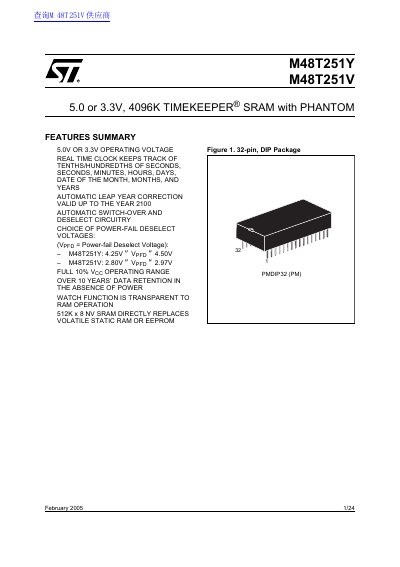
The document details the specifications for the M48T251Y and M48T251V Timekeeper SRAM modules. These devices are 32-pin DIP packages that integrate a CMOS static RAM, a real-time clock (RTC), and a self-contained battery into a single unit.
| Capacity | 512K x 8 bits (524,288 words by 8 bits) |
|---|---|
| Operating Voltage | 3.0V to 5.5V (M48T251Y) or 2.7V to 3.6V (M48T251V) |
| Package Type | 32-pin Plastic Module DIP |
| Data Retention | Over 10 years in absence of power |
The M48T251Y uses a voltage range of 4.25V to 4.50V, while the M48T251V uses 2.80V to 2.97V.
Yes, the clock includes automatic leap year correction valid up to the year 2100.