
HCNR200/201 high linearity analog photocoupler is a high performance optical isolator with high linearity, low drift, wide bandwidth, high reliability and low cost.It is widely used in various applications requiring isolated analog signals.
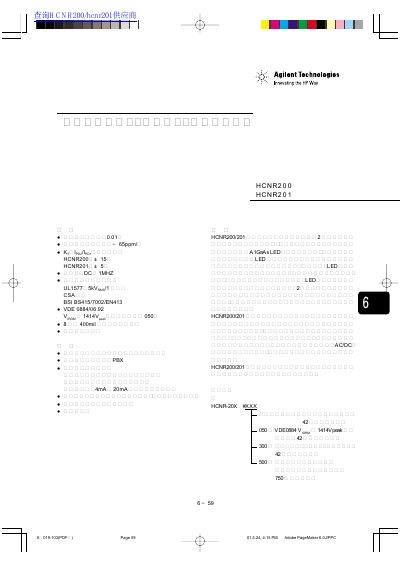
This document is a technical datasheet for the Agilent HCNR200 and HCNR201 Analog Isolator products. These devices are linear analog phototransistors composed of two matched photodiodes and a high-performance AlGaAs LED source, designed to provide excellent linearity and stable gain for isolating analog signals.
Key features highlighted include high linearity (0.01%), low gain drift (-65ppm/C), and a wide bandwidth from DC to 1 MHz. The datasheet details absolute maximum ratings, recommended operating conditions, electrical characteristics such as transfer ratio and current transfer ratio, and provides application circuit examples for various isolation needs including power supply feedback and motor voltage monitoring. This manual is written in Japanese.
| Gain Drift | -65ppm/C |
|---|---|
| Bandwidth | DC-1MHz |
| Transfer Gain (HCNR200) | +15% |
| Transfer Gain (HCNR201) | +5% |
| Operating Temperature | -40C to +85C |
The device uses an 8-pin 400mil wide body package.
The recommended operating temperature range is -40C to +85C.
The maximum average input forward current (I_F) is 20mA.