
This document is the instruction manual for the EMC and LVD M3 microphone. The microphone features a switchable PAD and high pass filter, making it suitable for both live performance and studio recording. The specifications include permanently polarized condenser, cardioid directional pattern, frequency range, output impedance, sensitivity, equivalent noise, maximum output, dynamic range, maximum SPL, signal/noise ratio, power requirements, battery life, and output connection.
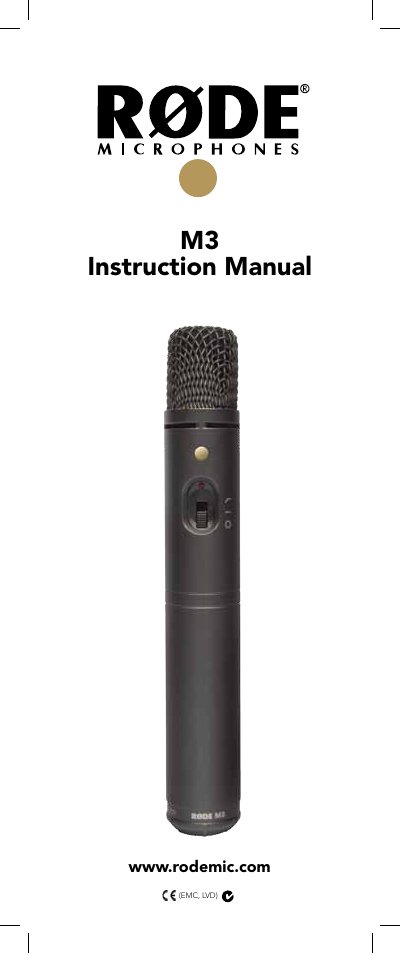
The Rodemic M3 is a permanently polarised condenser microphone designed for live performance and studio recording. It features a switchable PAD and high-pass filter to provide greater control over the sound source. The unit is battery operated for versatility in various locations and features a sleek black design.
| Acoustic Principle | Permanently Polarised Condenser |
|---|---|
| Directional Pattern | Cardioid |
| Frequency Range | 40Hz ~ 20,000Hz |
| High Pass Filter | 80Hz 12dB/octave |
| Output Impedance | 200Ω |
| Sensitivity | -40dB ±3dB re 1V/Pa @ 1kHz |
| Equivalent Noise | 21dBA SPL |
| Maximum SPL | 142dB |
| Power Requirements | 1.6mA - battery 6.5mA - 48V Phantom Power |
| Battery Life | >200 hours |
| Output Connection | 3 pin XLR |
| Net Weight | 390g |
| Dimensions | Length - 225mm Diameter - Ø33mm |
The M3 can be powered by either 9V battery or 24-48V phantom power.
The L.E.D. light will stay on continuously when the battery power is getting low.
The PAD setting provides a -10 or -20 dB reduction in sensitivity.
No, there are no user serviceable parts inside the microphone except for battery replacement.