
Fairchild AN-996 Using the FST Bus Switch as a 5V to 3V Translator

Describes how to use Fairchild FST Bus Switch as a 5V to 3V translator
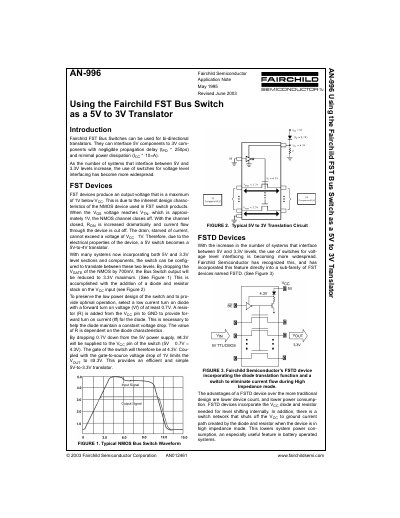

Fairchild AN-996 Using the FST Bus Switch as a 5V to 3V Translator - cover page
Brand
Fairchild
Category
Other Electronics
Document type
Application Note
Language
English
Pages
2
File format
PDF
File size
194 KB
Published
01 August, 2012
Updated
30 September, 2023
MD5 checksum
B9C6EB6A67A74DF31604258E69586813

About this manual

The document describes the use of Fairchild FST Bus Switches as bi-directional translators to interface 5V components with 3V components, noting negligible propagation delay and minimal power dissipation. It details a circuit modification involving a diode and resistor stack on the Vcc input to reduce the output voltage from 4V to 3.3V.

What's inside

  • Introduction
  • FST Devices
  • FSTD Devices
  • Special Considerations
  • Summary

Frequently asked questions

What is the maximum output voltage of an FST device without modification?

The output voltage is a maximum of 1V below Vcc due to NMOS design characteristics.

How can the Bus Switch be configured for 5V-to-3.3V translation?

By adding a diode and resistor stack on the Vcc input to drop the voltage by approximately 0.7V.

What are the advantages of FSTD devices over traditional designs?

FSTD devices offer lower device count, lower power consumption, and internal switching to eliminate current flow during high impedance mode.

Download PDF (194 KB)

More Fairchild Manuals


View all Fairchild manuals →