
The CS51312 is a synchronous dual NFET Buck Regulator Controller. It is designed to power the core logic of the latest high performance CPUs and ASICs from a single 12V input. It uses the V2TM control method to achieve the fastest possible transient response and best overall regulation. It incorporates a 5-bit DAC with 1.2% tolerance for 200ns transient loop response. It also includes a fast shutdown feature that can turn off the switches in a short time to provide protection against overcurrent conditions.
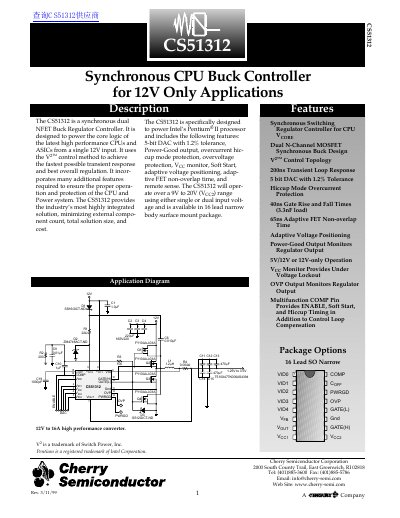
The CS51312 is a synchronous dual N-FET Buck Regulator Controller designed to power the core logic of high performance CPUs and ASICs from a single 12V input. It utilizes the V2 control method to achieve fast transient response and best overall regulation, incorporating features such as overcurrent hiccup mode protection, overvoltage protection, Vcc monitor, and soft start.
| Input Voltage Range | 9V to 20V |
|---|---|
| Transient Loop Response | 200ns |
| Gate Rise and Fall Times | 40ns |
| Adaptive FET Non-overlap Time | 65ns |
| Package Type | 16 lead narrow body surface mount |
The CS51312 operates over a 9V to 20V input voltage range.
The maximum operating junction temperature is 150°C.
The maximum gate rise and fall times are 80 ns.