
TPL-300 digital load cell amplifier can be used with all types of strain gauge load cells in weighing and force measurement.
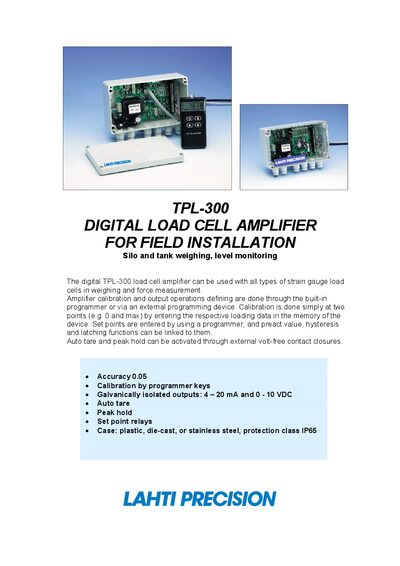
The TPL-300 is a digital load cell amplifier designed for field installation in silo and tank weighing and level monitoring. It works with all types of strain‑gauge load cells and offers features such as auto‑tare, peak hold, and set‑point relays.
The manual covers calibration using the built‑in programmer or an external device, describes the analog (4–20 mA, 0–10 V) and serial (RS‑232/RS‑485) outputs, outlines environmental limits, power requirements, and mechanical construction options (plastic, die‑cast, stainless steel, IP65).
| Accuracy | class 0.05 |
|---|---|
| Operating Temperature | -10 °C to +50 °C |
| Input Voltage | 230 VAC ±15 % (50/60 Hz) |
| Analog Output | 4–20 mA and 0–10 V (galvanically isolated) |
| Serial Interface | RS‑232, RS‑485, 300–9600 baud |
| Weight | 780 g |
Calibration is performed at two points (e.g., 0 and max) by entering the loading data into the device’s memory using the built‑in programmer or an external programming device.
It offers galvanically isolated analog outputs of 4–20 mA and 0–10 V, as well as serial communication via RS‑232 and RS‑485 with selectable baud rates.
All TPL-300 variants have an IP65 protection class.