
This document is the instruction manual for the HI 83209 Multiparameter Bench Photometer for Education. It includes specifications, precision and accuracy, operational guide, and measurement methods for various testing parameters.
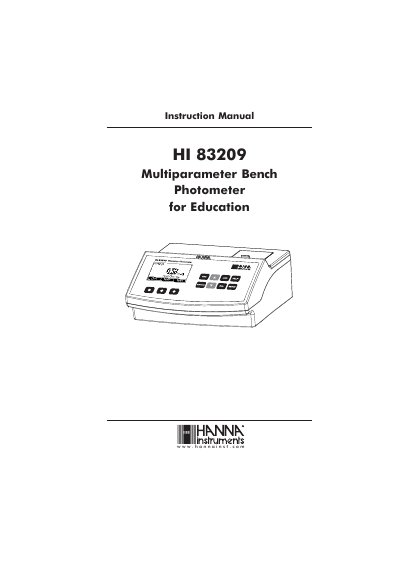
The Hanna Instruments HI 83209 is a multiparameter bench photometer designed specifically for educational purposes. It measures 20 different methods using specific liquid or powder reagents and features a powerful interactive user support system with a tutorial mode. The instrument can be connected to a PC via USB to manage results using optional compatible software.
| Light Detector | Silicon Photocell |
|---|---|
| Environment | 0 to 50°C (32 to 122°F); max 90% RH non-condensing |
| Dimensions | 235 x 200 x 110 mm (9.2 x 7.87 x 4.33") |
| Weight | 0.9 Kg |
All Hanna Instruments meters are warranted for two years against defects in workmanship and materials when used for their intended purpose.
The HI 83209 bench photometer can be connected to a PC via an USB cable.
It is necessary to cap the cuvette to prevent any contamination during the zeroing and measurement phases.