
Agilent CGH Analytics software uses industry-proven statistical algorithms to efficiently locate disease-implicated regions of genomic amplification or deletion from massive quantities of aCGH data. It identifies genome-wide aberration patterns from multiple aCGH profiles. These aberration patterns can be viewed in detail and compared, using a choice of display types. The software enables oncology, neurology and cytogenetics researchers to quickly determine copy-number based biomarkers and genomic abnormalities involved in disease processes.
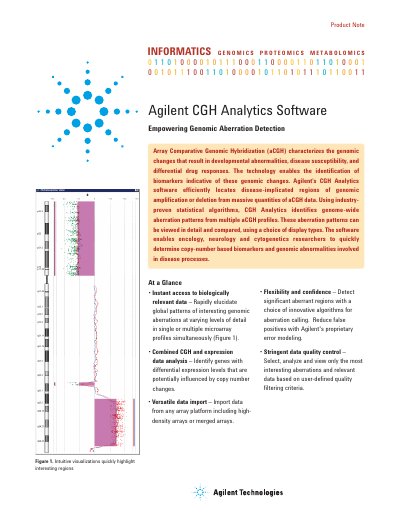
Agilent CGH Analytics software is designed to characterize genomic changes resulting in developmental abnormalities and disease susceptibility. It efficiently locates disease-implicated regions of genomic amplification or deletion from massive quantities of array comparative genomic hybridization (aCGH) data using industry-proven statistical algorithms. The software enables researchers in oncology, neurology, and cytogenetics to quickly determine copy-number based biomarkers and genomic abnormalities involved in disease processes.
| Operating System | Windows XP/2000, Mac OS X 10.4.x, Redhat Linux 9 |
|---|---|
| RAM | 2 GB |
| Display Resolution | 1024 x 768 |
| Disk Space | 4 GB |
| Processor | Pentium IV or faster |
| Recommended Processor | Dual CPU |
The software locates disease-implicated regions of genomic amplification or deletion from massive quantities of aCGH data.
The software runs on Windows XP/2000 with Pentium IV or faster, Mac OS X version 10.4.x with JVM 1.5.0, or Redhat Linux version 9.
The system requires 2 GB RAM, a 1024 x 768 display, and 4 GB of free disk space.